Showing posts with label battery storage. Show all posts

Monday, June 20, 2016

Diesel vs. Solar Generated Electricity in Botswana

Dumela*. As I have been travelling around Botswana visiting solar installations and chatting to solar system owners, I have encountered a lot of solar photovoltaic (PV) systems that have a diesel generator as back-up and so I have been fielding—and asking—a lot of questions about diesel versus solar. Most of my research has focused on solar systems with battery storage, but I decided that it was worth learning a little more about diesel generators: when and how they might be best combined with solar systems. In this blog, I share with you some of what I have learned.

Diesel (or petrol) generators have been around for a long time. They are robust and reliable, and there are numerous units from various manufacturers available in different sizes for different applications. They vary from small emergency generator units, which have a capacity of 2 to 5 kW, that you can purchase in a large supermarket along with your building supplies or groceries, to large units that serve as a back-up electricity supply for lodges, to even larger units that can power mining operations.

Diesel generators can even be used to add on-demand generating capacity to the electrical grid. For example, the Botswana Power Corporation (BPC)-owned 90 MW back-up generator operation in Orapa consists of two 45 MW GE LM 6000 turbine/generator units. Based on their specification data, when they are both running, these units can consume up to 22 000 liters of diesel per hour – that is almost one diesel tanker truck of fuel every sixty minutes! With diesel presently priced at about P 7.30/liter (US$2.52/gal), we can calculate that the Orapa station is, at capacity and just in terms of its fuel costs, generating electricity for ~P 1.78/kWh.

When considering off-grid electricity systems, the decision is usually made between selecting solar or a generator. In many respects, a diesel generator seems like a straightforward solution. The upfront costs are lower than those of a solar system; a generator is not dependent on sunlight and weather conditions; it does not need battery storage, and it is fairly easy to find technical assistance when the generator is not working. A small generator can even be loaded onto the back of a truck and transported to the repair shop.

On the down side, diesel generators are noisy, low-efficiency, highly polluting devices that require the transportation and storage of diesel. Typically, only about 25 to 37% of the energy in diesel is converted to electricity: the rest is lost as heat from the engine block and the hot exhaust gases.

Another complicating aspect of diesel generator operation is that generators burn a minimum amount of fuel, even at very low electrical demands. As Figure A shows, for a range of generator sizes, fuel consumption increases as the electrical load increases; however, at very low electricity demand, the consumption levels off. As a result, generators can be horribly inefficient (<15%) and wasteful devices at low loads. This escalates the cost of producing electricity at low demand levels, as shown in Figure B. If you need to turn on just a single light, you will need to fire up the generator–which will consume a minimum amount of fuel. It is for this reason that generators are often paired with some battery storage that can take care of minimum load requirements. Also bear in mind that these cost data were calculated using a relatively low diesel cost of P 7.30/liter: as recently as 2014, diesel was selling for over P 10/liter (see Figure C below).


Data Source: Able Sales
Data: World Bank and OANDA

Figure B indicates that the fuel costs of generating electricity from diesel generators is of the order of P 2.00 to P 2.20/kWh at demand levels above 50%, but this is only part of the story. To get a sense of the overall true costs of diesel generation, we need to include the purchase and maintenance costs of the generator.

To calculate the all-in lifecycle costs, we need to calculate the levelized cost of energy or LCOE. This parameter takes into account the initial cost of the unit, its electrical output, the annual cost of fuel, annual maintenance, and an interest cost (normally set by the minimum rate of return one would like to earn on a project and is often equivalent to the bank loan interest rate to purchase the equipment). These costs are then distributed evenly over the life of the project to yield a single “levelized” cost for energy. The attraction of the LCOE approach is that it allows a side-by-side comparison of different projects and energy sources that have very different financial requirements and expense flows. For example, it allows comparison of a solar system with high capital but low operating cost with a diesel generator project that has low capital but high operating costs. LCOE provides a means for determining which project is better from a lifecycle energy cost point of view.

Calculating the LCOE from scratch can be challenging as it is a rather involved financial calculation, but there is a great site, from the National Renewable Energy Laboratory in the US,  that can do the calculations for you. I used this to calculate the LCOE for a diesel generator. My set of assumptions included the following:

Capital cost: P 5000/kW ($ 450/kW @ P 11/US$)
Capacity factor: 90% (Generator runs most of the time)
Project lifetime: 10 years
Interest rates: 10% (Prime (6%) + 4%)
Diesel consumption rate: 0.27 L/kWh
Costs for diesel: P 7.30/L ($ 2.41/gal, June 2016)
Cost per kWh: P 1.71/kWh ($ 0.17/kWh)
Annual maintenance costs: P 330/kW ($ 30/kW)


With these assumptions, the calculator yielded the results in the figure above, indicating that the LCOE for a diesel generator is of the order of $ 0.183/kWh or P 2..01/kWh. I then computed the variability of the LCOE with high and low levels of some of the assumptions and generated the chart below. 

 
The data indicate that the cost of energy from diesel is most sensitive to the cost of diesel. Large increases in diesel prices lead to much higher costs for generated electricity; big increases in the cost of the generator do not significantly impact the electricity cost. The chart shows, within this span of assumptions, that the range of LCOE for diesel generators varies from P 1.86 to P 3.38/kWh, with a median value of P 2.62/kWh. To put these values into context, it should be noted that the average resident in Botswana, using more than 200 kWh/month, is paying P 0.88 per kWh (US$ 0.08/kWh @ P 11/US$) for electricity from the grid. In other words, within our chosen range of assumptions, the median cost of diesel-generated electricity is three times that of electricity purchased directly from BPC. So, if you have a grid connection and you install a diesel generator, do not consider the generator as a substitute for BPC: it is there to be used only when electricity is not available during load shedding.

Returning to the central theme of this blog (that of solar vs. diesel), let’s have a look at the LCOE for an off-grid solar installation with battery storage. The assumptions that I used for this calculation are as follows:

Capital cost: P 60 050/kW ($ 5500/kW @ P 11/US$)
Capacity factor: 90% (With battery storage, the system operates most of the time, like a diesel system)
Project lifetime: 10 years
Interest rate: 10%
Cost for fuel: Free!
Annual maintenance costs: P 55/kW ($ 5/kW)

I used local prices for the installed cost of a solar system with battery storage that I obtained from vendors here in Botswana. I also chose 10 years as a project lifetime to allow a direct comparison with the diesel project and because this is the typical lifetime of batteries under ideal conditions.  However, I will note that battery lifetime in Botswana can be a lot shorter as a consequence of the impact of high ambient temperatures.

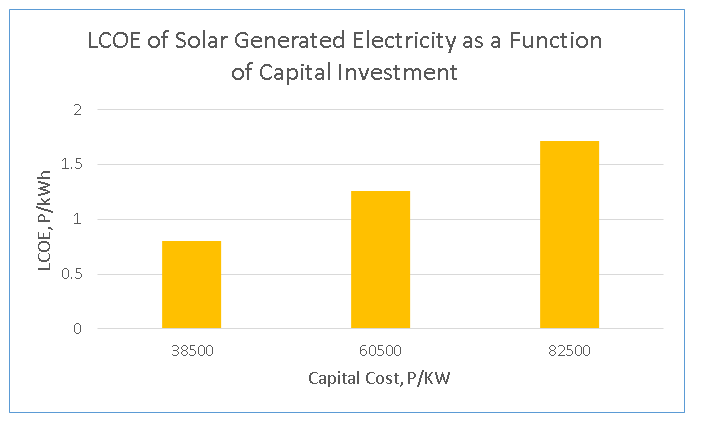
Using the above assumptions, the LCOE for solar power calculates at P 1.25/kWh. This is still higher than the cost of grid-supplied electricity from BPC, but is almost half the cost of diesel-generated electricity.  The chart below shows how the LCOE changes with capital costs: as expected the costs for solar generated electricity are highly sensitive to the upfront costs.


LCOE comparisons for diesel vs. solar with battery storage are summarized in the table below.

It should be noted that I have included some pretty significant assumptions in my calculations, but the key points to note from these data are that (i) the capital cost of solar plus battery storage is 12 times that of a diesel generator with the equivalent capacity; (ii) the lifetime costs of electricity for diesel generators are twice that of solar. These options are both more expensive than electricity from the grid in Botswana.

When considering diesel vs. solar, the decision comes down to one of high upfront costs and low long-term operating costs compared with low upfront costs and high operating costs. It is clear from the financial data that solar, even with the costs of battery storage included, is the better option. The biggest obstacle to investing in solar is finding that substantially larger amount of money for the one-time installation of the solar and battery storage system.

However, (as these matters often are) it is sometimes not a black or white decision. Sometimes a hybrid solution, using a combination of solar and diesel, is the correct one. I noted in an earlier blog the disappointment many purchasers of solar have experienced due to poor battery and system performance. As I read and learn more, I am becoming convinced that the correct solution for off-grid systems is not diesel or PV: it is a hybrid of both. A long run of overcast days can really compromise the electricity output of a PV/battery storage system, so installing diesel generators alongside solar systems in a hybrid configuration can compensate for these weather shortcomings.

There are several other reasons why hybrid systems are a good choice. These include:

  • Improved reliability – crucial for service-oriented businesses, such as tourist lodges, which cannot afford to be without electricity;
  • Reduced capital costs – some diesel-generation capacity reduces the size and cost of the battery bank and solar array;
  • Better for short-term high-demand applications, such as stoves, welding machines, hairdryers, etc.;
  • Reduced emissions compared with a generator-only solution;
  • Reduced exposure to future diesel price increases;
  • Modular solutions are possible. As PV and battery prices decrease, more modules and/or batteries can be installed, leading to reduced fossil fuel use;
  • More system design options become available, for example, PV and no storage with generator or PV plus battery storage and a generator;
  • A hybrid solution is a partially “green” solution, but still allows optimization of capital expenditure. It avoids overspending on capital costs or underspending and then suffering from very high fuel costs.

Hybrid systems combining solar and diesel generators are growing in importance.  A number of island communities use them and there are a growing number of mining companies powered by diesel generators and using millions of liters of diesel fuel per year to power their operations that are finding big savings by introducing some solar generation into their energy mix. If you are interested in exploring hybrid options, I encourage you to take to look at the Homer Energy website and their Homer modelling tool. This enables you to investigate a range of hybrid options, all the way from 100% diesel to 100% solar and calculate the LCOE for each option. In this way, you can determine the optimal combination of solar and diesel for your application.


In conclusion, hybrid options seem to offer the best of both worlds. A hybrid system should have upfront capital costs somewhere between those of a diesel-only solution and a solar/battery storage system; the LCOE should similarly lie between those of both options. In turn, the resulting system has a higher degree of reliability, less weather sensitivity, and permits the installation of more solar and battery storage as time and finances allow. However, a combined system will no doubt be more complicated to operate, so if you have any direct experience with hybrid systems and their performance in the field, please share it with us in the comment box below.

In the meantime, remember to turn off the lights when you leave the room. 

Tsamayang Sentle**
Mike Mooiman
mooimanm@franklinpierce.edu


(*Greetings in Setswana)
(**Go well or Goodbye in Setswana)

Tuesday, March 15, 2016

Off-Grid Solar Power in Botswana

Dumelang*. My previous post looked at the limited number of grid-connected PV systems in Botswana. There appear to be only three of noteworthy size (>10 kW) and a small number of lower power residential systems. In this post, I turn my attention to off-grid systems, of which there are many more throughout Botswana, but let’s start by reminding ourselves about the differences between grid-connected and off-grid systems.

In grid-connected systems, the electricity flow is one of three types:
  1. Outwards only, whereby power generated by the solar operation is fed into the electrical grid to supplement the power produced by other power plants, e.g., the Phakalane solar farm;
  2. Inwards only, where the grid just serves as a backup and feeds electricity into the system when insufficient solar energy is being produced, e.g., the 34 kW system at Scales Associates in Broadhurst, or
  3. Bidirectional, whereby excess power, over and above that used locally, is fed into the grid during the day, but during the night power is drawn from the grid, e.g., the University of Botswana experimental project in Mokolodi Village.
In off-grid solar systems there is no connection to the electrical grid and these installations are typically found on homes, on farms, in villages, or at tourist lodges in remote areas. Because these systems cannot use the grid for back-up electricity supply, they usually incorporate batteries so that any excess energy, produced during the day, can be stored for use during evening hours. Off-grid installations are sometimes combined with other means of electricity generation, such as diesel generators, that can provide backup power during cloudy conditions or when the batteries are depleted. These are referred to as hybrid systems.

Understanding these off-grid systems requires knowledge of the four key electrical components of the solar system: the panels, batteries, inverters, and charge controllers. In an earlier blog I provided some details on the functions of these components. The figure below shows key components in the basic layout of an off-grid solar system.

As I drive around Botswana, I see off-grid systems almost everywhere I go. They range from small single-panel systems providing a small amount of power for few lights or mobile phone charging, to multi-panel systems powering a home/ farm or a borehole pump, to large systems powering tourist lodges in the Okavango Delta. My research at the Clean Energy Research Centre at the University of Botswana is focused on these off-grid systems and particularly the battery-storage component. I am visiting these systems, chatting to the owners about the performance of the units, taking measurements, and collecting data.

As I have noted before, there has been a big push for installing solar systems in Europe, USA, and parts of Asia. These installations range from residential installations to large grid-scale systems of the order of 500 MW. Most folks in the US and Europe who are installing solar systems on their homes or business are installing grid -connected systems. The driver for the rapid rollout in these locations is purely financial. Electricity in these places is expensive and attractive subsidies for renewable energy are available. Only a small fraction of these new solar installations are off-grid systems and they tend to belong to hardy self-sufficient folks looking to live “off the grid” or owners of holiday homes and cottages located in rural areas that are far from the grid.

In the developing world, and here in Africa, off-grid solar is a whole other matter. In an isolated community where a grid connection is not possible due to distance or the cost of connection, energy options are limited. Many people live without power and rely on wood for light and cooking, or sometimes they use kerosene and candles. If they have a generator, they have to deal with the transportation and expense of diesel to keep the unit running as well as the maintenance of the engine. Off-grid solar systems are often the only viable way to bring electricity to remote homes, communities, businesses, and tourist facilities. Once solar is installed the fuel, sunshine, is free and maintenance is fairly simple and a lot less than that involved than that required for a diesel generator.

On the surface, off-grid systems appear to offer many advantages:
  1. The obvious one is that they are not grid-connected: they thus avoid long waits to get a grid connection and save on grid connection fees, which can range from as little as P5000 (~US$450) for residences located closed to the grid to hundreds of thousands of pula for locations far away from the main grid.
  2. Once the investment is made, the sunlight is free, which can significantly reduce the daily operating costs of the installation, However, as I will point out in a future blog, even though this is often a compelling reason for solar, it is a simplistic assumption. The correct analysis is to consider the upfront costs as well as the operating costs or the total lifetime costs.
  3. Solar is “green” and a more sustainable energy option and avoids the noise and pollution of a diesel generator as well as the logistics of trucking and transporting large quantities of diesel into remote areas. In fact, for many tourist camps and lodges this becomes an important part of the branding and selling point for their operations. Visitors can visit remote camps and enjoy the peace and quiet of the African bush, and still have access to their electronic devices and other modern conveniences, such as gourmet coffee, hairdryers, hot water, and air conditioning, without a noisy diesel generator puttering away and polluting the environment. I, for one, have stayed at one of these lodges and when it becomes necessary for an operator to turn on the diesel generator late at night when the batteries are depleted, the racket, after the quiet of solar power, can be quite jarring.

On the other hand, off grid-solar systems present a variety of problems:
  1. The upfront capital costs are high.  Solar systems are expensive, especially when compared with an equivalent diesel system. Moreover, the need for battery storage can often double the investment cost.
  2. Excessive heat is a problem for solar systems. In a previous blog, I noted that solar panel performance decreases as temperature rises, so the high ambient temperatures and the high panel surface temperatures can significantly decrease the expected output and even the life of solar panels. Similarly, battery lifetimes and performance are very temperature-dependent. Batteries do not like high temperatures and their lifetimes are considerably shortened in Botswana’s hot conditions.
  3. The output of a solar system is very dependent on weather conditions. The ideal conditions are cool sunny days; day after day of cloudy weather will seriously compromise the functioning of a solar system. After the sun goes down, the performance of the system is dependent on the installed battery capacity and operation of the battery bank.
  4. For large loads, large numbers of solar panels and batteries are needed, which means that a large amounts of space for their installation are required. In a space-constrained operation, say an island-based tourist camp in the Okavango Delta, this could present a problem.
  5. Unlike a diesel generator, every solar system is a custom built and the performance of the installation is very reliant on the competence and experience of the solar contractor.
  6. The lifetime costs of solar, which include the upfront investment cost, maintenance costs, and battery replacement, can be high especially when compared with grid-supplied electricity.
I have visited a good number of off- grid solar systems in Botswana, ranging from single-panel systems to large multi-panel installations with massive battery storage and have learned a great deal about the performance of these installations in general. Here are some of my findings:
  1. There are a lot of off-grid solar of different scales and sizes scattered through Botswana. These range from 50 W single-panel systems used for cell phone charging and a few lights to 100 kW multi-panel systems at lodges in the Okavango Delta.
  2. The solar portion and electronics are, for the most part, robust and work well. However, panel degradation has been seen in some cases. I have seen panels with cracks in the glass which have allowed in moisture and I have seen panels with a distinct browning of their appearance. See the photos below. The browning is due to the degradation of the organic material (ethylene vinyl acetate) that is used to encapsulate the individual solar cells in a panel. This degradation is accelerated at high temperatures and by high solar irradiation – both of which are plentiful in Botswana.
  3. I am surprised at how many non-functioning systems I have found. Often times, systems have been donated to communities that benefit initially from the installations. This is then followed by years of a lack of attention and post-installation follow up. As a result, three to five years after installation, the systems are no longer working. In some respects, this is a typical development problem – well-intentioned donors donate systems which are installed and are just left to community to run. Insufficient thought is given to developing local expertise or training nor is any provision made for follow up.  Years later, when problems occur, there is nowhere for the community to turn to for repairs and, as a result, systems, which initially provided a benefit, sit idle.
  4. There is a lack of branding with solar systems and little public knowledge as to what to constitutes quality for these installations. Solar systems are built from a number of components and purchasers are reliant on the design expertise of their solar contractor and the equipment choices those contractors make. It is unlike buying a car where, if you pay a lot of money for a Mercedes, you can be sure you are getting the benefits of great German engineering, quality components, and great after-market service. With solar power, there is no single Mercedes brand – you are reliant on your vendor making the correct design and component choices for you. I will note that many solar vendors, concerned about their reputation, will make the correct choices; however, as with cars, watches, and many other consumer goods, you get what you pay for. Buying cheap components or trying to save money by installing fewer panels or batteries will result in an inadequate solar system.
  5. Load creep is a problem. Often a system is designed for a specific load, say on a farm, to run lights, a fridge, a TV, and a borehole pump. Over the years, more electrical devices are purchased, such as a second TV, more lights, a freezer, a printer, etc. As result, the electrical load grows and, after a number of years, the system is inadequately sized for the demands placed on it.
  6. Many folks, ranging from individuals, to businesses, to high-end tourist lodges, are to varying degrees disappointed in their installed solar systems. The solar systems initially appeared to provide an elegant, sustainable, quiet, non-polluting alternative to a diesel generator. Invariably, the disappointment is associated with the inadequacy and shorter-than-expected lifetimes of the battery-storage systems.
  7. The Achilles heel of just about every system I have visited are the batteries. The battery life is generally half, or even less in some cases, of that expected. This seems to be result of:
      • Poor system design and insufficient solar panel output;
      • Lack of battery maintenance;
      • High operating temperatures;
      • Greater draw on batteries than originally planned.

Many of these problems can be overcome by the correct design, the right components, and spending oddles of money for both, which bring us to the fundamental problem that plagues solar systems: high upfront costs. In my next blog, I will take a closer look at this problem and dig into a comparison of the lifetime costs of solar vs. diesel.

Until next time, remember to turn off the lights when you leave the room. 


Tsamayang Sentle**
Mike Mooiman
mooimanm@franklinpierce.edu


(*Greetings in Setswana)

(**Go well or Goodbye in Setswana)

Wednesday, January 27, 2016

Solar Power in Botswana – Photovoltaics – The Technology

Dumelang*. My last few posts have discussed the potential for harnessing energy from the sun in Botswana. Various ways of doing this include:
  • Concentrating solar power, where the energy of sunlight is focused by mirrors onto a focal point. The focused sunlight heats a fluid that is used to generate steam, which then turns a turbine to generate electricity.
  • Photovoltaic generation of electricity through the use of solar panels.
  • Solar thermal, which uses the heat of the sun to warm up water so that it can be used for showers and other hot water applications like washing.

In this post, I take a look at photovoltaic (PV) technology in general; the next blog will focus specifically on its application in Botswana. PVs generate electricity directly from sunlight using semiconductor technology, which is built into the PV panels. The ever-increasing scope of PV applications ranges from small devices that generate tiny amounts of electricity used to power calculators (outputs in the milliwatt (mW) range), to one- or two-panel systems generating 100 to 300 watts (W) to charge cell phones and provide light, to 2 to 50 kilowatt (kW) systems that power homes and businesses, all the way to grid-scale solar farms with outputs as high as 550 megawatts (MW). Today, we see PV applications all over the place; below are photographs of some solar installations I have observed in Botswana.


We will return to specific solar installations in Botswana later, but first let’s turn our attention to  looking at photovoltaic technology and the main components of a solar PV system.

PV panels produce electricity by the use of semiconductor technology. Most PVs are based on silicon semiconductors, but there are some newer panels that use non-silicon semiconductors. Silicon-based solar panels use bilayer materials of n- and p-type semiconductors. The n-type contains a small amounts of phosphorus in the silicon matrix which creates extra electrons in this layer and the p-type contains a small amount of boron which creates electron shortages or holes. At the junction of these two layers, the electron imbalance creates an electric field that can be used to control the flow of electrons. When panels are exposed to light, the photons in sunlight knock electrons from their positions in the silicon lattice and allows them to flow through an external electric circuit connecting the two types of semiconductor. This generates a small direct current which can then be harnessed. (For a more detailed explanation, here is a great YouTube video worth watching.)

Assembling many of these cells into a solar panel (modern panels typically contain 60 individual cells) allows their flows to be combined and permits larger flows of electricity. The first power solar cell was developed in 1954 and, since then, the key driver in solar cell research has been to improve the efficiency of these devices. Overall, solar panels are still low-efficiency devices with average efficiencies of converting sunlight to electricity of about 15%, although newer panels are now reaching efficiencies of the order of 22%.

The components of a solar system include the following:
  • Solar panels – Most commercially available panels measure ~1.6 m x 1 m and produce 150 to 250 W with a direct current (DC) output that can range from 15 to 60 volts and 3 to 7 amperes. The outputs of the individual panels are combined by wiring them in series or parallel configurations: connecting them in series boosts the output voltage, whereas parallel connections provide a larger current. The combination of these two wiring modes provides a range of voltage and current outputs that can be tailored to meet the requirements for a specific application.
  • Inverter – Most household and business appliances operate on an alternating current (AC) supply, so the direct current (DC) electricity that is generated from the panel must be converted to AC, which can then be feed directly into the grid or used locally. This is done by the inverter. Today, some DC appliances and lighting are available, which can eliminate the need for an inverter.
  • Charge controller – This is an electrical interface between the solar panels and the batteries that is used to ensure that the batteries receive the correct charging voltage and current. The electrical outputs of the panels vary during the day with changes in the sunlight intensity, so these devices prevent the over- and undercharging of the batteries. Charge controllers and inverters are often combined into a single multipurpose electrical component.
  • Batteries – These are usually lead acid batteries specifically designed for deep-discharge applications. They are quite different from car batteries. Car batteries are designed to put out a lot of power for just a short period of time to turn over the car engine when it is first switched on. Deep-discharge batteries are designed for cycling applications where there is moderate power draw over a long period of time, say during the evening, and recharging every day.  The two are not interchangeable. Not all solar systems include batteries, but battery storage systems are becoming an increasingly important. Many people have chosen to just install battery storage systems in their homes without solar panels to have some electricity available for when the electric grid is down during load-shedding periods. In a future blog, I will be taking a much closer look at battery storage systems.

There are two kinds of PV systems:  grid-connected and off-grid systems. In grid-connected systems, the AC output of a solar operation is fed into the electrical grid to supplement the power produced by other power plants. These operations usually do not include any storage so they can only generate and supply power to the grid during daylight hours. The supply from these operations is therefore highly variable: low in the mornings and afternoons, high at midday, and cloud cover significantly reduces their output. The electrical grid needs to be managed to adjust to this variable output. Most systems in Europe and the US are grid-connected and range from large utility-scale systems to smaller home-based units in which electricity produced during the day in excess of that used by the homeowner is fed back into the grid. These systems are often bidirectional: during the day, electricity is supplied to the grid; during the night, when no solar electricity is produced, power is drawn from the main electrical grid.

The other type of solar system is not connected to the main electrical grid. These are known as off-grid systems and are typically found on homes, on farms, in villages, or at tourist lodges in remote areas. These usually incorporate batteries so that any excess energy can be stored for use during evening hours. During the day, the sun generates electricity that is used to power the site, while excess electricity is stored in batteries to provide power for the evenings. Off-grid systems are sometimes combined with other means of electricity generation, such as diesel generators, that can provide backup power during cloudy conditions or when the batteries are depleted. These are referred to as hybrid systems.

Some solar systems combine grid-connected and off-grid systems. These have battery storage, but are also connected to the grid. These operations generate some or all of the electricity needed by the homeowner or business during the day and any excess is stored in the batteries (as opposed to sending it out to the grid); however, the grid connection is there to provide any shortfalls in power production from the solar panels or when the batteries are depleted. These systems offer the best of both worlds – they produce and use renewable energy so their electricity purchases from the grid are reduced, but the electrical grid is there as a standby to cover any shortfalls in energy production.

Although PV technology has been around for a long time and its applications have been expanding, it is only recently that we have seen significant growth: in fact, the roll out of electrical power generation from PV panels during the past decade has been quite phenomenal. The figure below shows the exponential growth. It was forecast that that there would be over 200 gigawatts (GW) of installed solar capacity by 2015—some 1% of the world’s total installed generating capacity—and that this would double by 2019 to 400 GW.

Source: Wikipedia

This growth has been driven by two factors:
  • Prices of solar systems have dropped, caused by improvements in PV technology, improved manufacturing processes, accelerated Chinese production, and, in some cases, the overproduction of solar panels. In 1977, the price of solar modules was $ 77/W; by 2013, the price had dropped 100-fold (!) to $ 0.74/W. This astounding price reduction is charted in the figure below. Today’s solar module pricing is now of the order of $ 0.50/W.
  • The implementation of renewable energy programs in Europe, Asia, and the US that offer large subsidies or feed-in-tariffs (FIT) has made the installation of solar power attractive for homeowners, businesses, and independent power producers (IPP).

 
Source: BNEF


The massive rollout of PV in these regions has made its way down to parts of Africa, notably South Africa. As part of its Renewable Energy Independent Power Producers Programme (REIPPP), South Africa has implemented 1059 MW of grid-scale PV solar projects, with an additional 1255 MW under construction or in development. This does not even include all the small-scale solar projects that businesses, homeowners, and farmers in South Africa have implemented.

Despite the large solar resource available in Botswana, this country has not been part of this rollout. In my next blog, we will look at some of the reasons for this. In the meantime, remember to turn off the lights when you leave the room.

Tsamayang Sentle**
Mike Mooiman
mooimanm@franklinpierce.edu


(*Greetings in Setswana)

(**Go well or Goodbye in Setswana)