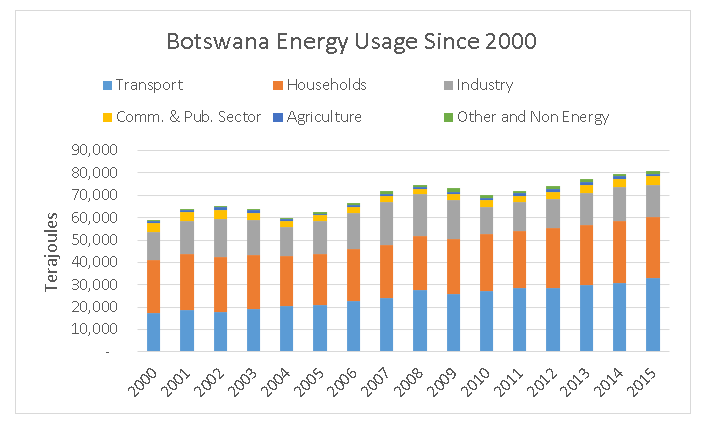
In Part 1, we looked at the big picture of energy supply and use in Botswana; in Part 2, we took a closer look at coal resources; Part 3 covered electricity generation and supply. In the final post of this series, we examine progress in the renewable energy field as well as government programs that will have an impact on the energy markets in Botswana.
Solar Power and Renewable Energy
With day after day of sunshine in Botswana, large tracts of undeveloped land and successful solar project implementation in other Southern African countries, there has naturally been a great interest in solar power in Botswana. However, progress and implementation have been limited and, as pointed out in a previous post, there are many reasons for this situation. The key explanations for the dearth of solar projects is the lack of regulations supporting independent renewable energy production, the low and subsidized cost of electricity in Botswana, and the absence of renewable energy incentives.
However, there has been encouraging progress recently. In June 2015, the Ministry of Minerals, Energy and Water Resources issued a request for expressions of interest (EOIs) to construct, maintain, and ultimately decommission a scalable solar plant near either Jwaneng, the diamond mine in the Southern District, or in other areas in Botswana. The EOI required interested parties to include proposals for independent power producer (IPP) license agreements, power purchase agreements (PPA), and the location of specific sites. The request was rather open-ended and non-specific regarding the capacity of the proposed operation, and appeared to be open to both solar power (CSP) and photovoltaic (PV) options. A great deal of interest has been shown in this process and 118 EOIs were received. Notwithstanding the interest shown in the project, no results were shared with the public and the exercise appears to have gone nowhere.
Just recently, on May 22, 2017, another EOI was issued by Botswana Power Corporation (BPC) calling for companies interested in participating in a joint venture (JV) for the development, implementation, and operation of a solar power plant, presumably a PV operation. This call was for a demonstration of capability, experience, and qualification to undertake the project: 166 submissions were received. A list of bidders is available online and the plan is develop a short list of potential JV partners and get the project started with the new partner by December 2017.
In October, Tobela Solar Power, a subsidiary of Kgalagadi Resource Development Company, trading as Solar Power in Botswana, signed a PPA to supply electricity from a 1 MW solar operation located in Tobela village near Shoshong. This is a culmination of many years of work by Morteza Abkenari, a long-time promoter of solar power in Botswana.
Also, as noted in Part 2, BPC issued a call, in May 2017, for EOIs to establish 20 mini hybrid power stations in rural areas to improve electricity access to isolated villages. Renewable energy is mentioned in the tender request and we assume that these plants would combine diesel generation with solar power. The plan is that bidders would design, build, and operate the plants and sell electricity to BPC via a PPA. There has been a great deal of interest, with 111 parties submitting bids.
The University of Botswana has been instrumental in installing a 20 kW experimental solar operation in Mokolodi village just outside Gaborone. The first component, the 5 kW system on the Village Clinic, was successfully commissioned in May 2016. This is the first bidirectional grid-connected project in Botswana. Any excess solar energy is fed into the BPC grid and, on cloudy days with little solar power generation, BPC supplies most of the electricity for the Clinic’s operation.

A solar energy trade group, the Solar Industries Association of Botswana (SIAB), has been established to promote the wide-scale use of solar energy. The group serves as a liaison between government, solar industries, academic institutes, and other groups working in the solar energy field in the country.
The Clean Energy Research Center (CERC) was established by the University of Botswana to advance interdisciplinary research, education, and advocacy for renewable and sustainable energy. CERC is involved in research, teaching, and advocacy in the areas of renewable energy and energy efficiency against the background of preserving the environment. The center operates the solar research project at Mokolodi and is the local partner for the SOLTRAIN solar hot-water initiative in Botswana (see below).
The commitment to protecting the natural environment is clearly evident in Botswana’s tourism industry. Eco-tourism has been building traction over several years and the country now boasts some of the most eco-friendly camp sites in the world. An estimated 1–2 MW of installed capacity of off-grid solar systems provide electricity and hot water to luxury exclusive tourist destinations nestled in the bush, mainly around the Okavango Delta. To mention only one group, Wilderness camps have done particularly well, installing 500 MW of photovoltaics . There are several other camps and lodges practicing the same philosophy. Further north, Chobe Safari Lodge also boasts the use of solar-powered boats and electric game vehicles.

Solar power in Botswana is more than the generation of electricity from PV panels. There are also solar thermal applications that use the energy of the sun to heat water for use in showers and other hot-water applications like washing. Solar hot water (SHW) has been promoted by the government since the 1970s and several initiatives have mandated the installation of SHW heaters on government buildings, such as clinics, schools and residences. Generally, however, the performance of these units has been poor and many of them no longer function – anecdotal information suggests as many of 90% of installed units are not operational. Reasons cited for their poor performance is the lack of regulations regarding their manufacturing, installation, and design criteria, poor water quality, and the supply of poor quality units. Many of these are now being replaced with electric hot water geysers.
Poor understanding of the installation and maintenance aspects associated with these systems is also a factor. To counteract this lack of knowledge, the Austrian Development Agency and the Opec Fund for International Development have established a program, the Southern African Solar Thermal Training and Demonstration Initiative, SOLTRAIN, to demonstrate the effectiveness of solar thermal systems in the Southern African region and to build the capacity to install and maintain these units. This program was rolled out in Botswana in 2016 and several training sessions, including technician-level courses, have been held.
Biofuels continue to garner attention. As noted in Part 1, a great deal of home heating and cooking are carried out using wood, particularly in rural areas. However, there is still great interest in biodiesel. The Japanese government has supported a multi-year research project in the production of biodiesel from the cultivation of Jatropha plants. Results have been mixed because cultivation of these crops in Botswana has proved challenging. Efforts to grow and utilize Jatropha in other parts of Africa have also had minimal success.
Energy-Related Government and Regulatory Changes
There has been some small-scale progress in the implementation of renewable energy in Botswana but, ultimately, significant progress will only occur with government support and the establishment of a consistent regulatory environment that permits and encourages independent power production. There have been some encouraging movements of late: we highlight the following:
- There has been some reorganization of government agencies and cabinet positions. Previously, energy matters fell within the Ministry of Minerals, Energy and Water Resources (MMEWR). Water resources has now been placed into the Land Management and Sanitation Services portfolio and the MMEWR is now the Ministry of Mineral Resources, Green Technology and Energy Security. This should permit a more focused approach to the energy sector.
- In the 2017/2018 budget, this revamped Ministry received the largest allocation (18%) of the P16.5 billion development budget.
- In an important step forward in allowing the independent production of power, the government has established an Energy Regulatory Authority for the water and power sector. This is a particularly useful move, as this authority will set out the rules for independent power production and allow its oversight. According to the legislation, the regulatory body would be responsible for:
- “ensuring sustainable and secure supplies in the regulated sector;
- setting and maintaining service standards;
- ensuring that tariffs in the regulated sector are fixed on the basis of a tariff methodology that has been set up in a transparent manner;
- ensuring that interests between consumer, customer and licensee are adequately balanced;
- protecting and preserving the environment; and
- ensuring that the regulation of the energy sector is done in accordance with the best international regulatory practice.”
- Botswana is working with the World Bank to develop a national renewable energy strategy. This is expected to focus largely on solar energy and financing of renewable energy projects.
- Botswana’s 11th National Development Plan for 2017 to 2023 highlights the importance of energy supply, on-going government support, and the key role that renewable energy will play in the future.
- Energy efficiency measures continue to be supported by the government and the importance of a national energy efficiency plan has been highlighted. In 2015, a tender was issued to develop such a plan for Botswana. No progress on further development has been published recently.
- At the 11th Conference of Parties on Climate Change held in Paris in 2015, a Green Climate Fund (GCF) was established to promote projects in developing countries aimed at reducing the impact of climate change. Botswana applied for funds and is moving forward with climate change mitigation projects, such as the installation of solar power, agricultural projects, and efficient water use.
Conclusion
In this four-part series, we have taken a look at recent developments in the energy sphere in Botswana. The progress in most areas is encouraging. Botswana is generating more of its electricity needs from its own coal-fired power plants and consequently relying less on imported electricity. There are projects underway to further utilize the country’s coal resource through the harvesting of coal-bed methane. There has been considerable progress in the renewable energy sector, with possible solar JVs, the first solar project PPA, and the commissioning of the first grid-connected bidirectional solar project. Government programs are supportive and forward-looking, and the establishment of an energy regulatory authority has been a very important step in the establishment of IPPs in Botswana. Generally, we are encouraged and we look forward to reporting more progress in next year’s update.
Ultimately, we all have a responsibility for energy use, so, until our next post, remember to turn off the lights when you leave the room.
Mike Mooiman and Karen Giffard