Showing posts with label concentrated solar power. Show all posts

Tuesday, January 12, 2016

Concentrating Solar Power in Botswana

Dumelang*. In my previous post, I discussed the potential for harnessing the energy from the sun in Botswana. I also pointed out the various ways of harnessing this potential:
  • Solar thermal uses the heat of the sun to warm up water so that it can be used for showers and other hot-water applications, such as washing;
  • Concentrating solar power, where the energy of sunlight is focused by mirrors onto a focal point: the focused sunlight heats a fluid, which generates steam, which then turns a turbine to generate electricity;
  •  Photovoltaic (PV) generation of electricity by the use of solar panels.
In this post, I focus on concentrating solar power (CSP). This option has been under consideration for several years in Botswana and may see implementation in the future.
Let’s begin by taking a closer look at the technology. There are two main types of CSP units: point-focus and line-focus units. Point-focus CSPs comprise an array of mirrors that reflect and focus the light of the sun onto a single point – normally a central tower. The mirrors, known as heliostats, track the sun’s path and the concentrated sunlight is used to heat a heat-transfer fluid, normally an organic liquid that can withstand very high temperatures (max. 400oC) or a salt mixture that melts at low temperatures.  This heated fluid, which can reach temperatures of 250 – 550oC, is then used to boil water, thereby generating steam that is used to rotate a turbine and generator to produce electricity.

A variant of the point-focus system involves a satellite dish-shaped mirror that focuses the energy of the sun onto a single point. This allows the operation of a Stirling engine, a special type of engine that uses heated air to generate electricity. Photos of these two point-focus systems are shown below.
  
Source: seia.org

Source: Wikipedia

In a line-focus system, sunlight is focused onto a pipe running down the focal line of a parabolic trough. In this approach, the focusing of sunlight and heating of the fluid is done locally within the trough, as opposed to a central tower. During the day, the troughs pivo to track the sun across the sky and all that is required is that the heated fluid be pumped through the pipes to a central steam boiler and generator unit. Some 80% of installed CSP systems are parabolic-trough systems because these lend themselves to offsite modular construction of the mirror and receiver components and because it is a more mature technology.  The troughs can be arranged in series and/or parallel configurations, which creates versatility by allowing a range of heat-transfer fluid temperatures and energy outputs tailored for different steam boiler and generation units. The components of a parabolic-trough system are shown in the figures below.

Source: US DOE

Source: cspworld.org

One of the most important advantages of CSP systems is that thermal energy can be stored by holding the hot thermal fluid in a tank. This provides a thermal reservoir that can be tapped to continue generating steam and electricity after the sun has set. CSP plants can be designed for up to 12 hours of thermal storage; storage for four to six hours of operation after sunset is normally considered sufficient. This represents a major improvement over utility-scale PV operations, which do not have a storage component. Typical output profiles of PV vs. CSP electricity production are shown below. The extended window of electricity production, especially during the high-demand evening hours, makes CSP systems more like traditional fossil-fuel systems and less like many of the other renewable energy systems (such as wind and PV) that are highly variable in output. Energy storage is a major benefit, but thermal storage adds considerable costs to the construction and operation of a CSP unit.


Most modern CSP systems have the following key components:
  • A solar field, which is the array of mirrors, heliostats, or parabolic troughs;
  • A receiver that absorbs the focused sunlight and heats up a heat-transfer fluid: this is the central tower (also called a power tower) for  point-focus systems  or a specially configured pipe with a coating designed for energy absorption for parabolic-trough systems;
  • A heat-storage system, which is series of tanks or containers to hold the warm heat-transfer fluid;
  • A power plant, which includes a steam boiler, turbine, and generator to convert the thermal energy into electrical energy;
  • A steam-cooling system to condense the steam back into water to allow for its reuse.
CSP systems are often compared with PVs in terms of technical complexity, energy output, capital cost, and the cost of electricity produced. It is clear that CSP systems are far more complicated operations than utility-scale PV systems. Like PV systems, they have large solar fields to harvest the sunlight, but they also require several additional expensive operations to transfer, store, and convert the captured thermal energy into electricity. CSP systems are therefore more expensive to install and operate. PV panels produce electricity directly and so capital and operating costs are lower. Generally speaking, kWh for kWh, PV is cheaper than CSP and prices for PV systems continue to fall.  

Moreover, CSP systems face the following additional challenges:
  • Water is needed to generate steam for the power plant and cooling systems are needed to condense the steam back into water for reuse. Because CSP systems are often located in desert or semi-arid areas, cooling systems involving water cannot be used and so forced-air cooling systems are required. These use large electrically driven fans, which consume a great deal of energy and therefore reduce the net electrical output.
  • Because of their location in arid environments, dust is a big problem for CSP systems. It coats the mirrors and reduces effectiveness of the system. In some areas, mirrors are cleaned – with water – every day.
  • Direct sunlight is required: cloud cover will shut down the operation of a CSP system. In contrast, PV systems can still produce electricity (although reduced amounts) on cloudy days from the diffuse sunlight.
  • Like other renewable energy systems, connection to the existing power grid is an important technical and cost factor. The choice of location is critical to avoid large expenses associated with building long transmission lines.
Notwithstanding these challenges, there are several CSPs, either proposed or under construction, in the Southern African region. Most notably, South Africa has instituted the Renewable Energy-Independent Power Producer Programme (REIPPP) and, since 2011, there have been four opportunities for companies to bid for wind, solar PV, and CSP projects as Independent Power Producers (IPPs). An impressive amount of interest has been shown and, so far, awards for over 3000 MW of renewable energy generation, involving $10 billion of investment, have been made. Even though the bulk of the awards have been for wind and PV, this program has been particularly positive for CSP projects. The first CSP project, a 100 MW parabolic trough system, the KaXu operation in Pofadder in the Northern Cape, operated by Abengoa Solar, came online last year. There is an additional 250 MW of CSP projects under construction—a 100 MW parabolic trough and a 150 MW power tower—and a further 250 MW under development. The REIPP program has been so successful that the bid price of electricity from CSP operations decreased by ~50%  over the first three bid windows.

A CSP project has also been proposed for Namibia and a feasibility study was recently completed. In Botswana, the implementation of CSP has been under consideration and study for a number of years. The review process has gone through the following steps:
  • In 2009, a pre- feasibility study that assessed the potential of a 200 MW parabolic-trough installation was completed. Five locations considered, including Selebi Phikwe, Maun, Letlhakane, Serowe, and Jwaneng.
  • In 2013, a feasibility study for a 100 MW power tower system was completed. The Jwaneng site was recommended and the installation of solar radiation monitoring installations at Jwaneng and Letlhankane was suggested.
  • A Request for Expression of Interest (EOI) to construct, maintain, and ultimately decommission a scalable solar plant near either Jwaneng, the copper mines in the North West Region, or other areas in Botswana was issued on June 7, 2015. The EOI required interested parties to include proposals for IPP license agreements, power purchase agreements, and the location of specific sites. Although closing of these bids was due on August 19, 2015, the outcomes have not yet been made public.
This recent EOI request is rather open-ended, not specific regarding the capacity of the proposed operation, and is open to both CSP and PV options. Earlier government comments suggest that there is interest in 50 MW of generating capacity in the North West Region near the Discovery Metals Boseto and proposed Khoemacau copper mines and 50 MW near Jwaneng (a diamond-mining area). Interestingly, the previous feasibility study advocating a 100 MW CSP option at Jwaneng was not  published nor shared as part of the tender process. If I was bidding, I would have wanted to see that report. Owing to lack of information, many companies would have had to individually prepare their own assessments from the ground up and probably needed to spend a considerable amount of time on site in Botswana. It is likely that this complicated the process and raised the cost of bid preparation. Perhaps there are good reasons for not sharing the earlier report, but they are not obvious. Nevertheless, based on recent reports, a great deal of interest has been shown in this process and 118 EOIs have been received.

Due to the high cost of CSP systems, I anticipate that most of the received bids will be for straightforward PV plants without storage. Even so, I believe CSP is an attractive renewable energy option for Botswana and the inclusion of a thermal-storage component would also enable the generation of electricity until about midnight each evening. On reflection, the South African REIPPP has much to recommend it: it has specific windows for bidding and mandates for specific technologies, such as PV, CSP, and wind. This approach provides opportunities for different IPPs, it promotes renewable energy diversification (cheapest is not always better), and it has resulted in significant decreases in the costs of electricity from renewable sources in just a few years.

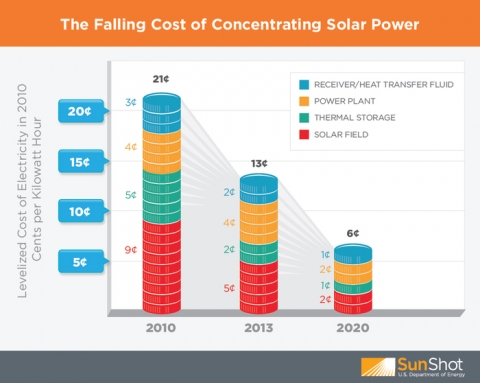
Costs of electricity from CSP operations are presently a limiting factor, but indications are that these will decrease. The US Department of Energy has projected that the cost of electricity from CSP operations with storage will continue to drop and has forecast a 3.5-fold decrease in electricity cost by the end of this decade (see the figure below).

Source: US DOE

I am certainly looking forward to more information on the Botswanan EOI and it will be interesting to review the nature of the proposals that were received. Given the open-ended nature of the request, ranking the proposals will be challenging, but I am hopeful that that the Botswana government will act on some of the proposals and that that we will see the installation of large grid-scale PV, and even some CSP projects, in the near future. In the meantime, remember to turn off the lights when you leave the room.


Tsamayang Sentle**
Mike Mooiman
mooimanm@franklinpierce.edu


(*Greetings in Setswana)

(**Go well or Goodbye in Setswana)


Monday, December 21, 2015

The Potential for Solar Energy in Botswana

Dumelang*. In my past few posts, I have focused on Botswana’s main energy resource: coal. However, Botswana has another very important energy resource that is presently poorly utilized: that of sunlight. Anyone who spends even just a little time in Botswana always marvels at the sunshine and the long days of clear skies that roll one into the next for weeks at a time. Combine this with vast expanses of low-population-density, semi-arid, flat countryside and the potential for tapping the solar resource of Botswana becomes obvious. In many countries, there is a remarkable roll-out of solar energy generation operations underway, both large and small scale, driven by improvements in technology and the falling prices of solar panels.  In some respects, Botswana is arriving late to the game, but, as I will highlight in future posts, there are positive steps being taken. In next series of posts, I will discuss various aspects of solar energy, how Botswana is benefitting from its ~3200 hours of sunshine per year, and how the country could further tap into this solar energy potential. 

There are several ways to harness the energy of the sun:
  • Solar thermal uses the heat of the sun to warm up water so that it can be used for showers and other hot-water applications like washing.
  • Concentrating solar power concentrates the energy of sunlight by mirrors onto a focal point. The focused sunlight heats a fluid, which is used to generate steam, which then turns a turbine to generate electricity.
  • Photovoltaic generation of electricity through the use of solar panels is the most widely used and most promising approach to tap into the sun’s energy. Its application is growing exponentially in many countries and it represents one of the most significant resources of renewable energy.

Each of these applications requires sunny days and the direct radiation of the sun, so let’s start with some measures of solar radiation. Botswana has about 300 clear days annually and, as noted above, about 3200 hours of sunshine. In comparison, the state of New Hampshire in the US, where my home university of Franklin Pierce University is located, has ~2500 hours of sunshine and only 90 clear days per year. For a more exact determination of the power available from the sun, we use the concept of irradiance, which is a measure of sunlight intensity on one square meter of horizontal surface at a point in time. This, of course, changes during the day: it is low in the early morning; at a maximum at noon when the sun is directly overhead; and then it tapers off towards evening. It also changes depending on the location, time of year, and the amount of cloud cover. The typical average peak irradiance at noontime is 1000 watts per square meter (W/m2) for the planet. This value is referred to as the peak sun value. Measurements of irradiance taken over one summer day at the University of Botswana in Gaborone 20 years ago appear in the figure below. It is notable that there are times when the peak irradiation is greater than 1000 W/m2, which is indicative of the solar potential available for harnessing.


Irradiance is a measure of the intensity or power of sunlight at a point in time, but what we are really interested in is the energy that we can harvest over a period of time. In an earlier post, I explained the difference between power and energy. Energy is the amount of power expended over a period of time (an hour or a day). The mathematical relationship between Energy and Power is given by the simple formula:

Energy = Power x Time

In the solar field, we determine the energy that can be potentially harvested over a day by calculating the area under the irradiance curve, such as the yellow area in the figure above. This measure of energy over a day is termed insolation; it is measured in kilowatt hours per square meter (kWh/m2). Another measure of insolation is to calculate how many hours of peak sun (with a fixed irradiance of 1000 W/m2) will deliver the same energy as the sum of the varying (irradiation x time) values over the day. The hours of peak sun per day is a particularly useful measure and is extensively used in the solar energy field to determine the daily output of electricity from solar panels. Insolation data are often available in tables of peak sun hours for different times of the year and different locations around the world. For example, the figure below shows peak sun hours for Gaborone at different times of the year and compares it with Manchester, New Hampshire, in the US (the location of Franklin Pierce University’s graduate campus). The differences are stark: the lows in the winter months in Gaborone are not that much lower than the highest value for Manchester in the summer! On average, the annual peak sun value for Gaborone s is 5.64 hours, while for Manchester, it is only 3.48 hours. This is to be expected, because the latitude of Manchester, NH, is further north (43o) than Gaborone is south (25o) and the former also has far more cloudy days.


Now these insolation measures are for a panel lying flat on the ground, but that is not the normal orientation for most solar projects. In the southern hemisphere, solar panels are angled towards the north, so as to capture as much sunlight as possible as the sun rises and sets in the northern skies. In the northern hemisphere, panels are angled towards the south. Typically, the mounting angle of the panels is equivalent to the latitude of the location: panels in Gaborone are often oriented at an angle of 25o from the horizontal. With the correct mounting angle, the average annual insolation value increases to 6.07 peak sun hours, an 8% improvement over a horizontally mounted panel. This is the average improvement for a fixed-angle array, but further improvements can be achieved by adjusting the orientation of the panels during the year. In winter, panels should have a higher mounting angle to capture the sunlight from the sun sitting low in the northern skies and, in summertime, the panels should lie flatter to catch the rays of the sun that sits high in the skies during the day. Some solar arrays are designed to allow for manual adjustment of the angle of the array during the year. If optimized monthly, a further 5% increase in the average annual insolation value over the fixed-angle array can be achieved.

Some solar arrays are very sophisticated, with intricate motor drives and control systems that can follow the sun from east to west during the day and also make small daily adjustments in mounting angle to follow the sun’s seasonal orientation.  Dual-axis systems, such as these, can boost the insolation by about 30% or more over a fixed-angle array. These dual-axis systems are expensive and maintenance issues with the drives and controllers often occur. Solar panels are pretty cheap these days, so a 30% gain in efficiency can rather be captured by simply adding more panels and avoiding the maintenance headaches. For this reason, most solar systems are simple fixed-angle systems.

Let’s return for a moment to measures of solar insolation. We have been using units of peak hours, which are particularly useful when calculating the energy that a photovoltaic (PV) panel will generate. Another useful unit is the direct measure of energy per square meter, i.e., kilowatt hours per square meter, kWh/m2. We determined above that the average peak hours for a horizontal array for Gaborone was 5.6. So, at a peak sun value of 1000 W/ m2, we can calculate the average annual insolation value as:

                5.6 hours/day x 1 kW/m2 x 365 day/year = 2044 kWh/year.

Of course, higher irradiation values created by improved mounting angles lead to higher annual insolation values. To gauge the amount of solar energy that can be harvested, maps of annual solar insolation have been prepared for the whole planet. Those below show the average annual insolation, in kWh/m2, for Africa and Botswana. An examination of the African map shows areas of very high annual insolations, >2200 kWh, particularly in the desert areas of North Africa, but also in areas covering a good part of Namibia and Botswana. The Botswana map shows that the best areas for high solar insolation lie in the western and northern parts of the country, particularly the Ghanzi and Maun areas.


It is clear that Botswana has large areas that are subject to high-intensity solar irradiation that can be used to generate electricity. In an earlier post, I noted that annual electricity consumption for Botswana in 2014 was ~ 4000 gigawatt hours/year (GWh/y) (one GWh is equal to one million kWh). Using a value of 2200 kW/m2 (such as that seen in the western and northern parts of the country), we can calculate roughly how much land area would be needed to generate Botswana’s annual electricity demand using the following assumptions:

PV panel efficiency: 15% (a typical value for modern panels)
Electrical and storage system losses: 50%
Panel coverage of land area: 50%

Based on these assumptions, we can determine that an area of approximately 50 square kilometers would be needed to generate sufficient energy to meet Botswana’s annual electricity needs. This hardly seems much in a country with a footprint of 566 730 km2. This suggests that it would not require much land area to generate all of Botswana’s electricity needs. However, it is important to put these fun-to-do order-of-magnitude calculations into perspective and to consider technical feasibility of these ideas.  

Let’s start with the size of the plant. Very large solar plants are being built today. There are several in the 550 MW range in the US and some larger ones are being planned. As of the date of this post, the largest solar power plant in the world is the BHE Renewables Solar Star operation in Antelope Valley, California. This is a 579 MW AC output plant, capable of generating ~1785 GWh of electricity per year or about 45% of Botswana’s needs. It uses 1.7 million solar panels and is located on 13 km2 of land. Technically, large-scale solar plants are feasible, but the costs are high. The cost for a 550 MW plant in California was reported to be $2.4 billion, which yields an installed cost of $ 4400/kW. Coal-fired power plants have lower installed costs (especially if pollution control equipment is not included)—of the order of $ 1300 to $ 2300/kW. However, one should not just consider capital costs, but operating costs as well. Taking into account all costs for a power plant is a complicated topic and it is a subject I will tackle in a future post.

Cost is an issue, but the bigger problem associated with solar power is that it is an intermittent and variable resource. Unlike a traditional power plant that can vary its output day or night (within a certain range), a solar resource can only produce energy during the daylight hours and is subject to the whims of cloud cover and passing storms – during which output can drop considerably. To fully utilize solar energy, we need electricity storage in batteries to provide power for the nighttime and when it is cloudy. Unlike grid-scale electricity generation from large PV plants, grid-scale battery storage is still in its infancy. It is complicated and very expensive. To date, the largest grid-scale battery-based storage operation is in Japan – a 40 MW unit with storage of 20 MWh. To store just three days’ worth of electricity for Botswana, would require some 40 GWh of storage. This is 2000 times the largest plant storage plant at the moment and is simply not feasible at this time. In many respects, generation of the electricity from sunlight these days is fairly straightforward; the storage aspect is the bigger challenge that we face this century.

This is the first in a series of posts about solar power and its potential for Botswana. I trust that I have given you a sense of the tremendous resource available and the scale that is needed to harness it, but also a sense of the technical challenges, complexities, and costs involved in developing this resource.

Until next time, remember to turn off the lights when you leave the room. 

Tsamayang Sentle**
Mike Mooiman
mooimanm@franklinpierce.edu


(*Greetings in Setswana)

(**Go well or Goodbye in Setswana)