Showing posts with label botswana power corporation. Show all posts

Sunday, November 12, 2017

2016/2017 Botswana Energy Update – Part 3: Electricity by Mike Mooiman and Karen Giffard

Following up on Part 1, in which we looked at the big picture of energy supply and use in Botswana, and Part 2 where we examined coal resources, we turn our attention in this post to electricity production, the Botswana Power Corporation, electricity tariffs, and appraise developments over the last few years.
Botswana Power Corporation (BPC) is the government-owned electrical utility and is the only entity that is responsible for the supply, transmission, and distribution of electricity throughout Botswana. As a result, discussions about electricity in Botswana often center on BPC and its operations and performance. Much of the electricity situation in the country is summarized in the figure below, where we have plotted data for the past 21 years. The blue bars show how the total annual amount of supplied electricity (generated locally and imported) has doubled over this time period. The orange line shows the percent of electricity generated in-country by BPC, largely from their Morupule operations. (Data for 2017 are estimates based on data from the first two quarters only.)
  Data Source: 1997 to 2004; Adjusted BPC annual report results. 2004-2017; Statistics Botswana

There are two important details to note from this chart. The first is the remarkable turnaround since 2011 in the amount of electricity generated in-country. It has increased from less than 10% in 2011 to an estimated 77% in 2017. This is a result of the improved operability of the Morupule B operation and it is likely that, within a few years, that Botswana could be generating enough power internally to supply all of its domestic needs. Remarkably, in July 2017, there was a report that Botswana had, for the first time, exported (!) electricity into the South African Power Pool for a short period.
The other point of note is that the amount of electricity supplied from both local generation and imports appears to have peaked and levelled off since 2014 at just below 4000 GWh. The data from the first two quarters of 2017 suggest that there might even be a further drop in electricity supply in 2017. This decrease in supply could result from several reasons: less demand from the mining industry due to the closure of the BCL copper and nickel mine, reduced diamond production, energy-efficiency drives, and perhaps more temperate weather that required less heating and cooling.
For many years, electricity generation in Botswana was a disappointment. The Chinese-built Morupule B 600 MW coal-fired power plant experienced operating problems right from the start. There were many problems with the contractor and operability of the equipment that impacted reliability and limited availability. A damning report released by the World Bank highlighted many project errors, including selection of an unqualified contractor, safety issues on site that resulted in five deaths during construction, and poor project overview by BPC.
According to the 2015/2016 BPC annual report, Morupule B only had availability of 55.8% compared with the expected 89%. Although progress has been made in improving the operability of this plant, problems with the contractor, China National Electric Equipment Company, remain and cost overruns have ballooned. The investment in Morupule B and the electricity imports to cover for its lack of operation are now of the order of 12 billion pula ($1.2 billion) and the Botswana government is negotiating to sell Morupule B back to the contractor, following which BPC will buy back the electricity though a power purchase agreement.
At the same time that Morupule B was being commissioned and was experiencing operating problems, the ageing Morupule A plant was shut down in 2013. To compensate for the Morupule B problems, a decision was subsequently made to refurbish the Morupule A operation. This is being undertaken by Doosan, a South Korean company. The scheduled completion date is December 2017, but delays have been experienced.
Despite the many problems associated with the Morupule B plant, the recent good news is that its operability has improved and, according to the chart above and data from a recent Statistics Botswana report, local generation of electricity has improved. In the first two quarters of 2017, more than 75% of the power needs of the country were locally generated. The equivalent numbers a year earlier were ~50%.
Even as the refurbishment of Morupule A is taking place and the reliability of Morupule B is being improved, plans for further expansions of Botswana’s generating capacity are underway. A 300 MW expansion of Morupule B to build two more 150 MW generating units (Units 5 and 6) was agreed to by a joint venture formed by Marubeni from Japan and Posco from South Korea. The joint venture was to act as an independent power producer and would design, build, and operate the plant to sell power to BPC under a negotiated power purchase agreement. However, progress on this project has now been halted owing to issues of loan guarantees for $800 million and contention regarding the proposed power purchase rates.
Negotiations are also underway with Kepco and Daewoo from South Korea to build another 300 MW (Units 7 and 8) of generating capacity. If all the units at Morupule are built and the refurbishment of the 132 MW Moropule A plant is completed, this would give Botswana a coal-fired generating capacity of 1332 MW. This would be well in excess of its present peak needs and will allow for electricity exports and growth in local demand.
It should be noted that the potential expansion of Morupule B and the award of contracts to foreign companies has been criticized by several local energy companies that have coal resources and that had made progress in developing their projects in order to bid competitively for greenfield 300 MW generating sites, in line with a 2013 Botswana government tender.
Generally speaking, there are a lot of electricity-generation projects on the drawing board and under discussion, including the mostly unexplored potential of solar generation. The table below lists the existing generating facilities (highlighted in yellow) and those in planning that we are aware of (highlighted in green). It is unlikely that all these projects will be developed, but it is encouraging that there is so much focus and interest in developing electricity generation in Botswana.


As Botswana’s only electricity utility, BPC has struggled with insufficient income and financial deficits for many years, although the annual report for 2015/2016 did show the deficit shrinking. Operating deficits have been made up by cash infusions from the government. As a result, electricity in Botswana is heavily subsidized. Recent BPC data show that ratepayers are paying only about 60% of the cost of electricity: the average cost for procured electricity in Botswana (local generation and imports) is 139 thebe/kWh (US$ 0.14 kWh), whereas the average selling price to ratepayers is 82.1 thebe/kWh (US$ 0.082/kWh).
BPC is working hard to transform itself and to deal with its operating deficit. It has recently appointed an ex-patriot CEO from Germany and has prepared a turnaround plan called MASA 2020 that focuses on cost cutting, operational efficiency, selling of assets, and working with independent power producers. In line with many power companies across the world, BPC is looking to transform itself into a transmission and distribution utility, as opposed to a fully integrated generation, transmission, and distribution entity. The plan to sell problematic Morupule B back to the contractor that built it is part of this strategy. BPC is attempting to address the deficit/government subsidy issue by increasing electricity prices and improving operational efficiencies. In April 2017, electricity prices were increased between 8 and 13%, with the largest increases leveled at medium and large businesses.
Another challenge for BPC is that not all of the electricity generated or purchased from the South African Power Pool makes its way to customers. There are expected losses in the transmission and distribution grid due to the resistance of the wires, but there are also losses due to theft or meters not correctly recording actual electricity usage. It is notable that the losses from the BPC grid are large. The chart below shows that the recorded electricity losses, as determined by the difference between supply and customer sales, generally exceed 10%; based on the most recent data, these losses have risen to 15%. Such losses are considered large: global average transmission and distribution losses numbers, as determined by the World Bank, are 8.3%. Losses at Eskom in South Africa are typically 9% or below. Electricity losses in other neighboring countries are also high, e.g., Zimbabwe at 16.4%, Zambia at 15%. This represents an important opportunity for improvement.


In summary, the electricity situation, at least in terms of local electricity generation, has much improved during the past few years and as a result coal mining has also increased. It seems that load-shedding (rolling blackouts), as experienced in 2013/2016, could be a thing of the past due to local generation improvements and reduced electricity import costs with the economic downturn in Southern Africa. However, dealing with electricity blackouts, due to unexpected or scheduled maintenance inconveniences, is still very much part of life and doing business in Botswana. Nevertheless, we are encouraged at the progress that has been made.
In Part 4 of this series, we turn our attention to renewable energy projects and various government programs directed at the energy sector.
In the meantime, remember to turn off the lights when you leave the room. 
Mike Mooiman and Karen Giffard

Saturday, January 30, 2016

Why is There so Little Solar Energy Generation in Botswana?

Dumelang*. In my recent series of posts, I have been taking a deep dive into solar power in Botswana. I have looked at the large solar resource available in this sun-drenched country, I have considered the potential for concentrating solar power, and, in my previous post, I looked at the technology of photovoltaics and the world-wide rollout of this technology. As I read about solar and travel around the world, I am amazed at the proliferation of this technology. It already generates 1% of the world’s electricity supply and the International Energy Agency has forecast that by 2050 this value will rise to 16%.

Country after country is climbing onto the solar PV bandwagon and, even in Africa, there is some progress, particularly in South Africa. As part of its Renewable Energy Independent Power Producers Programme (REIPPP), South Africa has implemented 1059 MW of PV solar projects, with an additional 1255 MW under construction or in development. This excludes numerous small-scale solar projects that businesses, homeowners, and farmers in South Africa have implemented.

Despite the large solar resource available in Botswana, Botswana has not yet joined the PV movement. In this post, I take a look at some of the reasons for this.

Large-scale application of solar in Botswana has been limited to a single project: a 1.3 MW solar farm near Phakalane, just north of Gaborone. This project was built and funded by the Japanese government in 2012  who contributed P84 million of the overall cost of ~P106 million (~USD $10 million). This project has delivered close to its planned output, but, unfortunately, recent theft of copper cables and solar panels at the facility has shut down production since December 2015.

Another grid-connected system includes the recently constructed, but not yet operational, 20 kW EU-funded University of Botswana research system installed in Mokolodi village, just south of Gaborone.  Both of these systems will be discussed in detail in my next blog.

The only other large grid-connected system is a 34 kW system, owned by Scales Associates and located in Broadhurst, Gaborone near the Western Bypass. This system generates electricity for an office and workshop complex. It has a battery storage component and only uses the grid to supplement supply during shortfalls in produced solar power: it does not feed excess electricity back into the grid. There are, however, many small and large off-grid systems in Botswana that power homes, offices, businesses, and tourist lodges. Part of my research during my stay here in Botswana has been to visit and assess these smaller systems and to learn about issues associated with their operation.

Generally speaking, there are a limited number of PV systems in Botswana and the existence of only a single 1.3 MW utility-scale PV operation in a country with such a high degree of solar potential seemed, initially, to be astounding.  Clearly, lack of solar irradiation is no excuse. In an earlier post, I pointed to the high levels of solar irradiation in this region and the potential to harvest it. Besides, there have been many articles in the press and literature extolling Botswana’s solar potential.

The limited number of solar facilities in Botswana was at first a puzzle for me, but, since my arrival, I have spoken to a good number of people with knowledge of solar energy regarding the lack of solar power production in Botswana. Most have had opinions on this matter and a variety of explanations has been provided. The explanations and my thoughts on each are shared below:

  1. The costs of installation are high. This excuse was compelling many years ago, but prices have come down—exponentially. Solar systems now cost a fraction of their prices ten years ago and costs continue to decrease; however, they are still not cheap.  As noted in a previous post, costs for large-scale solar PV operations are of the order of $ 4400/kW. Coal-fired power plants have lower installed costs (especially if pollution control equipment is not included)—of the order of $ 1300 to $ 2300/kW. But this is only part of the story. A correct comparison should consider not only capital costs, but also long-term operating costs. Operating costs for solar plants are a small fraction of those of coal plants: compare the cost of sunshine with that of mined coal. If we quantify the higher long-term operating costs of burning coal, as well as its deleterious impacts, such as greenhouse emissions, general pollution, and health impacts, solar becomes an attractive proposition.                                                                                                                                                                                                                                         
  2. Lack of regulation supporting independent renewable energy production. This is a valid excuse. Botswana has taken steps forward in implementing legislation for independent power production. In 2007, the Electricity Supply Act was amended to permit Independent Power Producers (IPPs); however, legislation is just the first step. The next—and more important—step is setting up a regulatory body and framework for IPPs and considering renewable energy feed-in tariffs (REFIT). Many of the regulations are still in the discussion or proposal stage and are, as yet, not codified. This creates uncertainty for investors and discourages investment in the power sector. One of the concepts I drill into my students who enroll in Franklin Pierce University’s MBA in Energy and Sustainability Studies is that successful energy project implementation requires three components: it requires the correct technology; it needs financing; and, very importantly, it requires well-established, supportive, and consistent regulation. These days, there are many technological solutions to produce renewable energy and many firms willing to make investments, but they will only do so when the correct laws and regulations are in place. One just has to view the success of renewable energy legislation in other countries to see the benefits. The South African Renewable Energy-Independent Power Producer Programme (REIPPP) is again a case in point: since the legislation enabling this program was passed and firm regulations were established, regulatory uncertainty was no longer an issue and private investors have lined up to make large investments in grid-scale renewable energy projects. The results have been impressive: awards for over 3000 MW of renewable energy generation, involving $ 10 billion of investment, have been made. Now it is unlikely that Botswana, with its lower population (2 million compared with 55 million in South Africa) and commensurately lower energy consumption, will ever see this level of investment, but some investment in the renewable sector is desirable. To promote IPPs and/or renewable energy production, the government will need to move forward on setting up a regulatory body and framework. This will then create the regulatory confidence that will draw in investment.                                                                                                                                                                                                           
  3. The low and subsidized cost of electricity in Botswana. The cost of energy in Botswana is a big issue. Generally speaking, the cost of electricity in Botswana is low compared with that of other countries in the world. At this time, the average resident in Botswana, using more than 200 kWh/month, is paying 88.28 thebe (1/100 of a pula (P), the currency of Botswana) per kWh,  which is equivalent to US$ 0.0762/kWh (@ P11.59/US$). Compare this with the average costs of electricity in the US  at $ 0.1273/kWh and Germany  at $ 0.3140 $/kWh. Electricity in Botswana is heavily subsidized. The chart below compares Botswana Power Corporation’s (BPC) average selling prices and costs for electricity over time: it can be seen that the purchase price of electricity in Botswana is consistently lower than the costs. It is also notable that the difference over the past few years has escalated, which is one of the main reasons that BPC has been running with an operating deficit. This low subsidized cost of electricity makes it difficult for ordinary folks in Botswana to consider renewable energy. The low price of grid-provided electricity and the high installation costs for solar, especially when combined with battery storage, makes payback periods very long—it is simply easier and cheaper to use electricity from the grid. Under these circumstances, it takes dedicated, far-thinking, altruistic individuals concerned about the fate of the planet to make the investments in solar against the headwind of low electricity prices.                                                                                                                                                                                                                                                         
    Source: BPC  
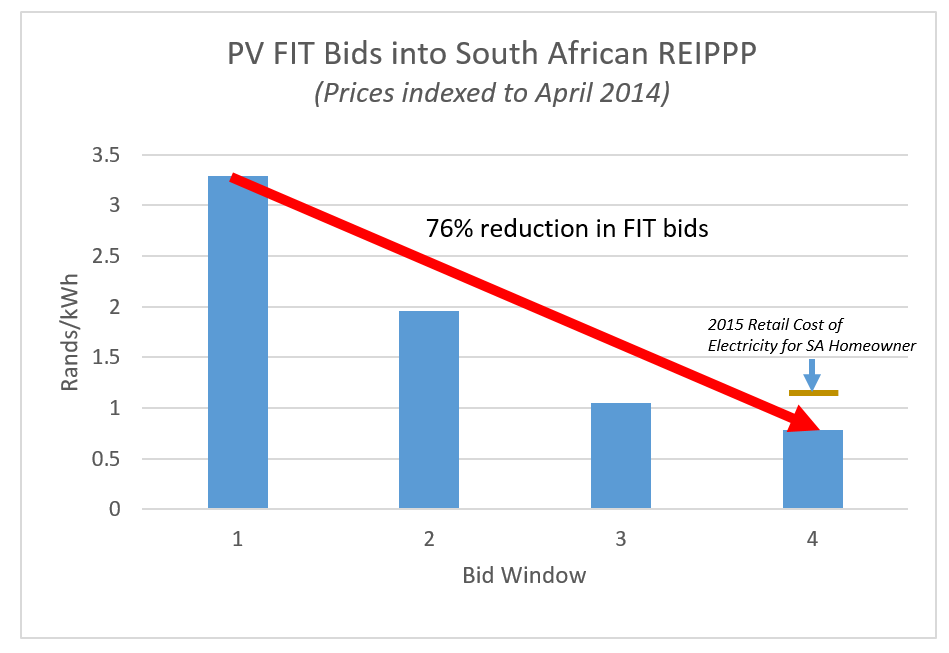
  4. Renewable energy is expensive. The cheap price of retail electricity in Botswana further complicates matters because REIPPs may initially require higher feed-in tariffs than the present retail rate of 88.28 thebe/kWh to run a profitable renewable-energy enterprise. Again, lessons can be drawn from the South African REIPPP. At the start of this program, bid prices in the auction were high, but then, over the succeeding annual bid windows, prices fell as investors gained confidence and experience in the South African renewable energy market. When the program started in 2011, the average bid for renewable energy was R 3.29/kWh (US$ 0.198/kW @ R16.61/$). This has decreased every year and fell to R 0.79/kWh ($ 0.047/kW) in the most recent bid window – a remarkable 76% reduction over four years. This is below the R 1.14/kWh that the average homeowner (using <600 kWh/month) is paying the national electricity supplier, Eskom (see the figure below). The program is a fine example of the results that a well-crafted, consistent, and predictable program can deliver. If large-scale renewable energy/solar is introduced to Botswana, it is very likely that the average tariff required by the developers for the first projects will be higher than the retail price for electricity. In a way, this will become a subsidy for renewable power and is similar to the subsidies presently supporting coal-fired electricity generation in Botswana. Yet, drawing from the South African experience, there is the possibility that, over time, as more projects become implemented, the bid prices for renewable tariffs will decrease, although because Botswana does not have the same degree of needed capacity, such decreases will most likely be smaller.                                                                                
                                                                                                                             Source: SA DOE
  5. Solar energy is highly variable: it only produces electricity during the day and what Botswana needs is more consistent base-load production of electricity. I cannot argue with the point that Botswana needs a larger amount of reliable base-load electricity generation, especially considering that the writing of this post was interrupted several times by the lack of electricity due to load shedding. However, even though solar energy is variable, the production of electricity from PV systems will lessen the amount of coal that needs to be burned during the day time. Reduced coal burning has a positive impact on the planet and environment, it extends the lifetime of the coal resources, and it provides some diversification for electricity generation, which, in turn, reduces the vulnerability of energy supply.                                                                                                                                                                                                                          
  6. There is a lack of knowledge about solar systems and lack of trained personnel in Botswana. I have found this to be only partly true. There are a limited number of Botswana-based solar firms and trained personnel at the moment, but this is due to the limited amount of business available in the country. I have met several competent and well-trained engineers and technicians in the PV field in Botswana and I am confident the knowledge and expertise base will grow as the business grows – as it has in all other countries where solar energy has been promoted.                                   
  7. Concern about the impact of grid-connected PV systems on the main electrical grid. The connection of multiple small generators onto an electrical grid does add complexity to its operation, but the experience of other countries can easily and quickly be drawn upon. Major utilities in Europe, Asia, and the US now accommodate large-scale and highly variable renewable energy production from thousands of individual systems that each feed small amounts of electricity into their electrical grid, as well as from grid-scale PV operations. This is a technical problem that has been solved and Botswana can draw from a well-established knowledge base.                       
  8. Renewable electricity from PV is highly subsidized in developed countries. This is a valid point. We are seeing residential and grid-scale solar installations rolling out across parts of the US and Europe, but this is not because solar irradiation levels are high in these regions. In fact, they are often far lower than Botswana. For example, in my home state of Massachusetts, where there is a major growth in the solar industry, the average solar insolation value  is 3.9 peak sun hours compared with 5.6 in Botswana. Similarly, in Germany, solar irradiation levels are a lot lower: 2.52 in Hamburg and 2.98 in Munich. The reason for the solar bonanza in those countries is that there are tax credits for installation, high FIT levels, and/or generous renewable energy credits to be earned. For example, in Germany FITs in 2015 were € 0.1288/kWh (US$ 0.14/kWh). (This is down from 2004 when they were as high as € 0.54/kWh (US$ 0.67/kWh).) In Massachusetts, excess electricity generated by homeowners can be sold back to the grid for $ 0.1837/kWh through net metering and also earn the homeowner ~$ 0.30/kWh in renewable energy credits.                              
  9. At this time, there are better alternatives for Botswana than renewable energy. Botswana is a developing country and, as such, there are perhaps better alternatives to installation of expensive, long-payback renewable-energy projects. A reading of the most recent annual report for Botswana’s electrical utility, BPC, indicates that their focus is on base-load energy supply, transmission grid reliability, service delivery, financial turnaround, and rural electrification. Renewable energy is not even addressed. Moreover, discussions that I have had with various BPC personnel also suggest a very different viewpoint: when they view the P100 million Phakalane solar PV project, they see a good and interesting project producing enough electricity for 200 to 300 homes, or enough for one village; however, they then emphasize the fact that this same sum of money could be used to bring the grid to approximately 30 villages and impact a lot more people. Ultimately, this is a very important choice to make in a country with limited resources: impacting the lives of many in the short term by extending the grid and burning more coal or that of a few for the long term by installing solar. This is a complex matter, but it is very relevant to the situation in developing countries across the world. It is easy for those of us in the developed world to promote renewable energy, but we have the resources, incomes, the developed economies, and the completely electrified countries to make these choices. Sometimes what works in a developed country is a poor fit for a developing country.

It has taken me some time in Botswana to understand the complexities involved in the consideration and installation of solar projects. Sunshine is a magnificent energy resource for the country and it is clear that small off-grid systems with battery storage in remote areas and a long way from the grid are great alternatives to diesel generators. However, when it comes to large-scale grid-connected systems, the situation is a lot more complicated than I first appreciated and requires a nuanced understanding of the factors at play in the country. One has to balance the short-term needs of development and electrification against the long-term benefits of renewable energy production. One has to understand that renewable energy is not free energy – even though prices are falling: the initial costs are still high and the reason we are seeing large-scale solar PV roll outs in other countries is because energy costs are high and renewable energy is heavily subsidized. Furthermore, one has to deal with the variability of a solar resource and balance that against the need for reliable base-load generation, even though that is achieved by burning coal.

Overall, as these matters often are, it is a complex situation involving a great number of tradeoffs, but this is not to say that solar and renewable energy do not require regulatory and financial support. They do – and there are clearly actions that can be taken to promote solar, such as implementing FIT regulations, establishing subsidies, and training workers skilled in the solar energy business.

It has taken time to come to grips with the complexities of renewable energy in this part of the world. My understanding has evolved and my opinions regarding solar in Botswana are now a lot more educated. Clearly, there is still much to learn and I would be interested to hear your thoughts about this issue. Feel free to drop a comment in the box below or, if you prefer, drop me a note at my email address.

In the meantime, remember to turn off the lights when you leave the room.

Tsamayang Sentle**
Mike Mooiman
mooimanm@franklinpierce.edu


(*Greetings in Setswana)

(**Go well or Goodbye in Setswana)


Friday, October 23, 2015

Electricity Production in Botswana

Dumelang*. My post this week is part informative and part instructional. When we discuss energy issues, a couple of key concepts come up time after time and, to be a contributor to an energy discussion, we have to know, or familiarize ourselves with, some technology and terminology. In this post, I want to explain two fundamental energy concepts. The first is the difference between energy and power, and the second is capacity factor. I will then show how they can be applied to electricity production in Botswana. 

Let's start with the difference between energy and power. These terms are often used interchangeably. This is okay in a general conversation, but in an energy-related discussion, it can lead to confusion, misunderstanding, errors and bad decisions. It is essential to be specific about which term you are discussing, so let’s take a look at distinguishing between the two.

The standard scientific definition is that Energy is the ability of a system to do work. It is the quantity which we need to get something to move, heat up, light up, burn, explode, etc. Energy is not just one thing, however – it comes in different forms, for example, electrical energy, chemical energy, nuclear energy, kinetic energy, etc.: much of energy technology deals with converting one form of energy to another in the most efficient manner. For example, converting the chemical energy in petrol into the kinetic energy of a moving car.  Some of the more common units of measurement for energy are kilowatt hours (kWh), megawatt hours (MWh), megajoules (MJ), and terajoules (TJ).

Power, on the other hand, is the ratio of energy per unit of time or the rate at which energy is produced from a fuel source or is converted from one energy type into another. Units of measure for power include kilowatts (kW), megawatts (MW), joules/second or horsepower (HP).

The confusion between these two often stems from the similarity of the units like kilowatt hours (which is an energy unit), and kilowatts (which is a power unit). However, it is necessary to understand that, even though the units seem similar, there is a world of difference between them. This difference stems from the simple mathematical relationship between energy and power:

Energy = Power x time.

One my students in the Energy and Sustainability program at Franklin Pierce University  noted that energy and power are analogous to distance and speed. Energy, like distance, is a quantity, whereas power is a rate like speed. Like the relationship between energy and power, the relation between distance and speed is written as:

Distance = Speed x time.

Let's consider a simple backup generator that I have been looking at in the Game Store in Gaborone. 


This unit is rated at 5500 Watts or 5.5 kilowatts (kW) under long-term running conditions, so the power of the unit is 5.5 kW. If I were to run this unit for 1 hour, I would produce:

5.5 kilowatts (kW) x 1 hour = 5.5 kilowatt hours (kWh)

of electrical energy that I could use to run my home. Running it for 24 hours would produce 5.5 kW x 24 h = 132 kWh of electrical energy. The power rating of 5.5 kW is a measure of the rate at which the backup generator can take the chemical energy in the diesel fuel and convert it to electrical energy that I can use to keep my home running during load shedding. The larger the motor on the generator, i.e., the greater the power, the faster is the rate of energy conversion.

Let’s take a look at another example. In a car, we convert the chemical energy in petrol into forward kinetic motion to get us from point A to B. Again, the greater the power of the engine, the faster will be the rate of energy conversion. The pictures below illustrate this point.


The Mercedes S500 sedan has a high-powered 5 liter, 302 HP motor that can more rapidly convert the energy in the petrol tank into forward kinetic motion than my rental Toyota with its  1.5 liter, 89 HP motor. These two automobile engines, under specific circumstances, can produce the same amount of energy, however, the Mercedes can do so in substantially less time. It is likely that the Mercedes will do so a lot less efficiently than the Toyota—but with a whole lot more fun.
 
Let's go back to the Ryobi generator unit so that we can discuss the second fundamental concept for this post – capacity factor. If I could run the generator solidly for 24 hours a day for an entire year, I theoretically could produce:

5.5 kW x 24 h/day x 365 day/year = 48 180 kW of electrical energy.

However, if I were to use the generator only for 1 day per month during the year, say during a load shedding, I would produce:

5.5 kW x 24 h/day x 12 days = 924 kWh of electrical energy.

Dividing actual produced energy by the maximum that theoretically could have been generated in a 24/365 scenario produces a ratio called the capacity factor. In my example above, we would divide 924 by 48 180 to produce a figure of 0.019, which converts to a percentage of 1.9%: this would be the capacity factor of my generator for that year. In other words, my generator only ran at 1.9% of its maximum potential output. Students in the energy field often confuse capacity factor with conversion efficiency and it is important to appreciate that they are very different concepts. The capacity factor is a measure of how much of the theoretical capacity of an energy-generating device was utilized over a time period, typically one year. On the other hand, conversion efficiency is a measure of the effectiveness of the conversion of one form of energy, say that in coal, to another form of energy, for example, electricity. We will be taking a look at conversion efficiencies in a future post.

With these basic terms—energy, power and capacity factor—under our belts, let's turn back Botswana energy issues and particularly electricity generation.

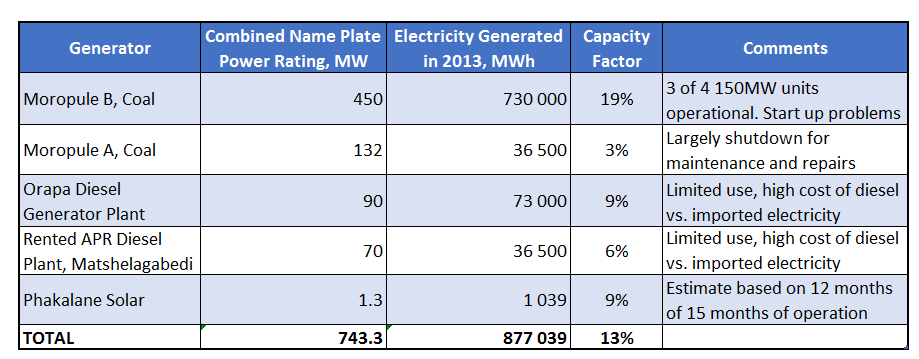
I have examined the 2013 electricity generation figures for Botswana that were published in the Botswana Power Corporation (BPC) 2013 Annual Report and have combined, in one table, the  generating units, their combined power, the energy produced from these units, the  calculated capacity factors, and the overall capacity factor for the combined generators in Botswana.


In 2013, there were five energy-generating operations, including the new (and trouble-prone) generators at Moropule B, the aging and largely shutdown Moropule A operations, two large-scale diesel generating operations, one near Orapa and the other near Francistown, and the 1.3 MW solar plant in Phakalane. The combined nameplate capacity of the generating units was 743 MW and they generated just over 877 000 MWh of electrical energy for an overall capacity factor of 13%. (Note that there are 1000 kilowatts in a megawatt, similarly there are 1000 kilowatt hours in a megawatt hour.)

On examining the capacity factors, it is interesting to note how far they are from 100%. The only way a generating device can run at a capacity factor of 100% is by running 24 hours 365 days a year—which is simply not practical or realistic. Equipment breaks down and has to be repaired or has to be shut down for maintenance. Moreover, operators of power plants make operating choices, based on the cost of coal and diesel compared with that of imported electricity, as well as demand to throttle back their units from their rated or name plate capability. This reduces the amount of electricity produced which, in turn, reduces the capacity factor. However, the low capacities of the coal-fired units are of concern. Typically, coal-fired plants have capacity factors that range from 50 to 80%, depending on location and demand. Low capacity factors for coal-fired plants result from either low demand or operational issues. In the case or Moropule B, the problems that have plagued the startup of new generators have been extensively reported on in the media.

Generating electricity using diesel is an expensive proposition and therefore the low capacity factors of diesel plants are not surprising. These units are seldom used and they function as back-up generators and are only used in an emergency. In many respects, they are just like the Ryobi generator I presently have my eye on.

Even though the Botswana-based generating units are operated separately with different technical and economic considerations, it is useful to consider their aggregated capacity. As noted above, the combined nameplate capacity of the generating units is 743 MW. This combined capacity in a single unit would be one mammoth-sized generator – we could call it the "Botswana Megarac 743" – which is almost a 140,000 times larger than the Ryobi unit I am eyeing at the Game Store in Gaborone. Looking at this another way, if Botswana bought 140 000 of these units, it would match the country’s present generating capacity.


Based on 2013 financial year data, this Botswana Megarac 743 was operated at a capacity factor 0.13 which means the combined Botswana facilities only generated 13% of the electricity that was theoretically possible. Over time, it is hoped that the start-up problems at Moropule B will be solved and the overall capacity factor for Botswana’s generating facilities will increase. However, we need to keep in mind that practical considerations, such as cost and availability of imported electricity, will also have to be factored in and that Botswana electricity generation is not an island unto itself. Botswana draws electricity from the Southern African Power Pool (SAPP) power generation and transmission system which coordinates electricity supply and demand throughout Southern Africa.  The SAPP system has a combined capacity of about 55 000 MW of electrical generating capacity.

Hopefully, this has been an informative and instructional post and you now know the difference between energy and power and you have an appreciation for capacity factors. As you can see, capacity utilization of generating facilities is low in Botswana: hopefully this will improve in the future, but it is crucial to appreciate that not all of this capacity can be tapped at any one time. Running these generators depends on complex issues, which include demand, cost and availability of fuel, maintenance shutdowns and financial considerations.

In the meantime, if you see me in the parking lot at the Game Store in Gaborone trying to load up that Ryobi generator into my rental Toyota, stop and give me a hand. Until next time, remember to turn off those lights when you leave the room.

Tsamayang Sentle**
Mike Mooiman

(*Greetings in Setswana)
(**Go well or Goodbye in Setswana)