Sunday, February 14, 2016

Grid-Connected Solar Energy Projects in Botswana

Dumelang*. In my previous post, I took a good hard look at why there is so little photovoltaic (PV) solar power generation in Botswana and shared with you some of the complexities involved in implementing large-scale solar here. Botswana does have an impressive solar resource, but its exploitation requires a great number of tradeoffs. As a result, there are a limited number of larger-scale solar systems in the country. In this post, I focus on the grid-connected operations. These are systems that feed power back into the grid or that use the electrical grid as a backup, i.e., the grid makes up for any shortfalls in energy generation by the PV unit. I will look at off-grid systems in my next post.

There are presently three large grid-connected systems in Botswana: a single large-scale 1300 kW solar farm in Phakalane to the north of Gaborone; a recently constructed, but not yet operational, 20 kW EU-funded University of Botswana research system installed in Mokolodi village, just south of Gaborone; and a 34 kW system, owned by Scales Associates and located in the Broadhurst area of Gaborone near the Western Bypass. There are a number of other small-scale installations with similar configurations, i.e. grid connected but just using the grid as backup,  that have been installed on residences in Gaborone and surroundings. This post takes a close look at the first two of these grid-connected projects.
   
The Phakalane 1300 kW Solar Power Plant

On the southern outskirts of Phakalane, some 15 km north of the capital, near an industrial area and partially surrounded by undeveloped land, sits the 1300 kW project (see Google Earth view below). The facility is located on 2 hectares and is surrounded by a sturdy fence supplemented with electric fencing and rolls of razor wire and there is a guard permanently on duty at the gate. An informative signboard provides information about the project and a diagram shows the main components.


Phakalane Solar Farm Information Board

The project was completed in 2012 and electricity generation started in August that same year. The projected was largely funded by P80 million  from the Japanese government and some contributions from Botswana Power Corporation (BPC) and the Government of Botswana. The total cost of the project was approximately P106 million (approx. US$13.4 million). Even at the time that the facility was built, these project costs were on the high side. Using an average 2012 exchange rate of P7.90/US$, the cost comes to $10.30/watt (W). Average costs for solar projects in other parts of the world were of the order of $3/W at this time. (In 2013 and 2014, utility-scale PV projects in neighboring South Africa were being installed for ~$3/W.)  Now, normally the first major project in any country is an expensive one because everything is new and more ground work has to be undertaken, but a price greater than three times international averages seems exceptional. This most likely contributes to the prevailing perception in Botswana that solar PV is expensive.

The system contains 5920 panels, each with a 220-W DC rating, which gives 1 300 000 W or 1300 kW overall rating. The panels are wired in strings of 16 panels connected in series to provide a peak voltage of 470 V DC. These strings are then combined in parallel with other similar strings and fed into combiner boxes and then into inverters. The electrical output of solar panels is always direct current (DC), but what we transmit over power lines and use in our homes is alternating current (AC), so the function of the inverters is to convert DC to AC. These inverters output 380 V AC, which is then ramped up to 11 000 V through a transformer so that it can be fed directly into the BPC power grid.

I am always impressed that an array of solar panels, each with an output of ~30 V DC can be combined, inverted, and transformed into a grid-compatible AC voltage of 11 000 V. For electric power engineers this is old hat, but I am always impressed. I have visited numerous power plants and am used to seeing large machines thundering away, devouring large quantities of fuel, and spitting out large volumes of waste heat, pollutants, and carbon dioxide to produce electricity. It is a therefore a pleasure to see a field of solar panels, each quietly converting sunlight to electricity and then using technology to configure wiring, inverters, and transformers so that the electricity can be boosted to a form that can be transmitted over the grid and used to power homes in other parts of the country.

In the energy field, one needs to be sure to understand what is meant by the rating of a power plant. Most power plants, say the 600 MW coal-fired operation at Moropule B, refer to their output of AC electricity. In this case, it is easy to calculate how much energy a power plant would generate over a certain time period. For example, if all the generators at Moropule B were running at their rated output, uninterrupted for 24 hours, the output would be:

600 MW x 24 hours = 14 400 MWh = 14 400 000 kWh (1000 kWh = 1MWh)

However, with solar PV operations, the rating is most often given as the combined DC output capacity of the panels under the standard irradiation condition of 1000 W/m2 at 25oC – the conditions known as one peak sun (see an earlier post for an explanation of irradiation and the peak sun hour concept). Although the amount of sunlight in Botswana is high relative to other parts of the world, the irradiation levels are only close to one peak sun at around noontime. A solar panel will therefore only produce its rated output for a short while around midday; the rest of the time, the irradiation is lower and the output is commensurately lower. The figure below shows recent irradiation levels for Gaborone, as measured by a weather station on the roof of the Faculty of Engineering and Technology building at the University of Botswana.


Because irradiation conditions change during the day, we determine the energy that can be potentially harvested in a 24-hour period by calculating the area under the irradiance curve—the yellow area in the figure above. This measure of energy is termed insolation; it is measured in kilowatt hours per square meter (kWh/m2). Another measure of insolation is to calculate how many hours of peak sun (with a fixed irradiance of 1000 W/m2) will deliver the same energy as the sum of the varying (irradiation x time) values over a day. The number of hours of peak sun per day is a particularly useful measure and is extensively used in the solar energy field to determine the daily output of electricity from solar panels. A typical insolation value for the Gaborone area is 6.09 peak sun hours. 

Cloud cover significantly affects the performance of solar panels: the figure below shows the contrast between a day with no cloud cover, February 1,  a day with lots of intermittent cloud cover, February 7 and Jan 14, which was overcast for the whole day: even with just passing clouds, the drop off in irradiation levels is significant.


In addition to a limited number of hours of peak sun per day and cloud cover, there are losses through the electrical system: in the wiring; in the conversion of DC to AC in the inverters; and through the transformers. Losses in PV systems are typically of the order of 20 to 30%.

There are also performance losses due to temperature. Intuitively, one would expect hot sunny days to be ideal for solar power generation, but one aspect of PV technology not often appreciated is that electricity output of PV panels actually decreases as the temperature increases by approximately 0.5%/ oC. Solar panels are rated for a temperature of 25oC. Panels operating in the Gaborone area, where the temperature on a summer’s day can be 35oC, can expect a 5% decrease in performance. Furthermore, when the clouds roll over the skies during the rainy season, we can also expect a big decrease in electricity production.


The European Commission’s Institute for Energy and Transport (IET)  has developed a great online calculation tool for estimating average losses and outputs for PV systems. One enters the geographic location, the rated power of the installation, and panel orientation and some very useful information on average irradiation, system losses, and PV output are generated. Alongside is the information I generated for the Phakalane location using this calculator.

As can be seen, the average losses were calculated to be 27%, the average daily peak hours were 6.49, and the average output was determined to be 6150 kWh/day, which totals 2240 MWh AC per year. With average systems losses of 27%, the output AC rating of the plant would be 819 kW.

During a recent (January 2016) tour of the plant, I was able to gather some information about its operation. It started up in August 2012 and since then has operated with only four months of downtime (June 2014, July 2014, Dec 2015, and Jan 2016), so the plant has operated for 36 months or 3 years. During this time, the plant has generated a total of 5286 MWh of electricity.

According to the IET calculator, the total electricity output over this time period should have been 3 years x 2240 MWh/yr = 6720 MWh, which means the plant has generated 79% of its expected output. The differences are due to: 1) lower solar irradiation levels during this period – data from the monitoring equipment at the Phakalane plant indicated average monthly irradiation levels of 161 kWh/m2 – rather than the 197 kWh/m2 used in the calculator; 2) the effects of cement dust from a nearby brick plant coating the panels and reducing their efficiency; and 3) a higher-than-estimated temperature effect on the panels. It always astounds me how hot solar panels get when they are exposed to sunlight: surface temperatures of solar modules can rise to greater than 70oC – much higher than ambient temperatures. At 70oC and with −0.5 %/oC performance losses, decreases in performance can reach as much as 23% at certain times during the day.

Another useful calculation is to determine the capacity factor, which is a measure of the proportion of its maximum output that a power plant actually delivers over a year. A capacity factor of 100% assumes that a power plant runs for 24 hours a day, 365 days a year. Coal-fired power plants have capacity factors of about 60%, nuclear plants 90%, wind plants about 35%, and solar PV plants are usually of the order of 26%. If we assume that the Phakalane plant has an output of 819 kW (assuming 27% system losses), we can calculate that over three years of operation:

Capacity Factor = 5 285 860 kWh / (3 yr x 365 d/yr x 24 h/d x 819 kW) = 24.6 %

This is in line with that expected for solar PV operations.


The Phakalane project is a well-designed operation and, like other PV plants, requires relatively little in the way of maintenance and operating costs. Costs include some electrical component maintenance, security services, cutting back of vegetation and weeds so that panels don’t get shaded, and the occasional washing of the panels. Unfortunately, it is located near a cement and brick factory and, as a result, there is a carryover of fine cement dust that settles on and coats the panels, especially those closer to the factory: a fair amount of effort is required to remove the encrusted coating on these panels.


The single biggest challenge for the Phakalane plant is vandalism and panel theft. There was recently intrusion at the site and large amounts of grounding cables were stolen for their copper value. Six panels were also stolen, despite the installation of special anti-theft fasteners on the panel attachments. As noted previously, the facility has been down since December 2015 and during my tour in mid-January I noted that repairs were underway. Hopefully the plant will be operational again before long.


As solar installations proliferate, panel theft is becoming a growing problem worldwide. Many installations are located in remote areas with limited security, so it is often easy for thieves to access the area and take their time to unbolt and load up the panels. Added to this, solar panel installations have large amounts of grounding wires, making them an inviting target for thieves who are looking to steal copper wire that can be sold to unscrupulous scrap dealers.

University of Botswana’s Mokolodi Village Project

To the south of Gaborone, and bordering the Mokolodi Game Reserve, is the small village of Mokolodi, which is home to about 600 people. This is a relatively new village by Botswanan standards and is surrounded by large properties and some high-end housing developments. Right in the heart of this village, the Clean Energy Research Centre at the University of Botswana has built, using money from an EU grant channeled through the African Union, a small, but in the history of solar power in Botswana—an important solar PV installation.

This will be the first of its type in Botswana to feed electricity produced in excess of that used onsite into the local low-voltage grid at 400 V. Phakalane is also a grid-scale project, but it is designed to feed all of its produced electricity into the high-voltage section of the national grid, whereas Mokolodi is designed first for local energy use and then for directing excess energy into the grid. It is important to appreciate that feeding excess solar power onto a grid is not a cutting-edge concept: in fact, it is the basis for most smaller solar projects installed in the US and Europe during the past decade or so. These systems are designed to generate electricity during the day to power the home or business; any excess generated is fed back into the grid and electricity is drawn back from the grid during the night hours as needed. Most of these systems are not designed with battery storage, so they are not self-contained off-grid systems: the grid is their backup system and they are very dependent on the grid to compensate for electricity needs at nighttime or for shortfalls during cloudy days.Another important aspect of these types of systems is that they are not a buffer against the effects of load shedding or other grid interruptions: when the grid goes down, they are designed to switch off immediately. This is to avoid little islands of solar electricity generation feeding electricity into a dormant grid and that could pose an electrical safety hazard for any electrical line workers who might be repairing lines in the area.

The Mokolodi system has a rating of 20 kW and, because it is an experimental system, consists of the following components:
  • A 5 kW system on the village clinic to provide daytime power for the clinic and to feed excess electricity into the grid;
  •  A 2 kW system on the home of the village Chief to provide daytime power and to feed excess electricity into the grid during the day;
  •  A 10 kW system at the Kgotla (meeting place), designed to power the Kgotla and some Village Development Committee owned homes during the day, with any excess fed into the grid;
  • A 3 kW experimental system that consists of three different types of silicon-based panels that their performance can be compared and contrasted;
  •  A small weather station to measure the solar irradiation, temperatures, and wind speed.

One of the more interesting aspects of this project is the direct comparison of the performance of the three types of panels (1 kW of monocrystalline silicon panels, 1 kW of polycrystalline panels, and 1 kW of amorphous silicon panels) under the energetic and harsh Botswana sunlight. UB researchers will be able to monitor their performances over the short and long term to determine which would be best for the high irradiation conditions here. The photographs below show some views of the Mokolodi project. 

13 kW University of Botswana Solar Installation at Mokolodi Kgotla


Once the project is up and running, the UB team is hopeful that the project will provide the following benefits:
  •  There are presently several non-electrified homes not connected to the grid. These homes will receive “free” solar power from the grid during the day; at night, they will draw power from the grid and pay normal BPC rates.
  • This is a demonstration installation for similar low-voltage grid-connected projects. It will allow BPC and the UB team to gather information and experience and open the way for the installation of similar systems throughout Botswana.
  • The generation of any extra power will be feed into the grid at no cost to BPC and, in a very small way, reduce the amount of coal that needs to be burnt.
  • It will be a valuable research tool for UB and its students and will allow the in-depth investigation of small-scale solar systems and their variability, their impact on the grid, and the performance of different panel types.
The UB team at the Clean Energy Research Centre will also be investigating the socioeconomic benefits to communities of free solar energy during the day and purchased electricity at night. The project is close to completion and hopefully will be commissioned in the near future. As the project moves forward and starts generating research results, I hope to share some details in a future blog.

This post has taken an in depth look at two important grid-connected PV systems in Botswana and in the next, I will be discussing the far more numerous off-grid systems that are scattered throughout the country. In the meantime, look out for solar projects and remember to turn off the lights when you leave the room.

Tsamayang Sentle**
Mike Mooiman
mooimanm@franklinpierce.edu


(*Greetings in Setswana)

(**Go well or Goodbye in Setswana)

Saturday, January 30, 2016

Why is There so Little Solar Energy Generation in Botswana?

Dumelang*. In my recent series of posts, I have been taking a deep dive into solar power in Botswana. I have looked at the large solar resource available in this sun-drenched country, I have considered the potential for concentrating solar power, and, in my previous post, I looked at the technology of photovoltaics and the world-wide rollout of this technology. As I read about solar and travel around the world, I am amazed at the proliferation of this technology. It already generates 1% of the world’s electricity supply and the International Energy Agency has forecast that by 2050 this value will rise to 16%.

Country after country is climbing onto the solar PV bandwagon and, even in Africa, there is some progress, particularly in South Africa. As part of its Renewable Energy Independent Power Producers Programme (REIPPP), South Africa has implemented 1059 MW of PV solar projects, with an additional 1255 MW under construction or in development. This excludes numerous small-scale solar projects that businesses, homeowners, and farmers in South Africa have implemented.

Despite the large solar resource available in Botswana, Botswana has not yet joined the PV movement. In this post, I take a look at some of the reasons for this.

Large-scale application of solar in Botswana has been limited to a single project: a 1.3 MW solar farm near Phakalane, just north of Gaborone. This project was built and funded by the Japanese government in 2012  who contributed P84 million of the overall cost of ~P106 million (~USD $10 million). This project has delivered close to its planned output, but, unfortunately, recent theft of copper cables and solar panels at the facility has shut down production since December 2015.

Another grid-connected system includes the recently constructed, but not yet operational, 20 kW EU-funded University of Botswana research system installed in Mokolodi village, just south of Gaborone.  Both of these systems will be discussed in detail in my next blog.

The only other large grid-connected system is a 34 kW system, owned by Scales Associates and located in Broadhurst, Gaborone near the Western Bypass. This system generates electricity for an office and workshop complex. It has a battery storage component and only uses the grid to supplement supply during shortfalls in produced solar power: it does not feed excess electricity back into the grid. There are, however, many small and large off-grid systems in Botswana that power homes, offices, businesses, and tourist lodges. Part of my research during my stay here in Botswana has been to visit and assess these smaller systems and to learn about issues associated with their operation.

Generally speaking, there are a limited number of PV systems in Botswana and the existence of only a single 1.3 MW utility-scale PV operation in a country with such a high degree of solar potential seemed, initially, to be astounding.  Clearly, lack of solar irradiation is no excuse. In an earlier post, I pointed to the high levels of solar irradiation in this region and the potential to harvest it. Besides, there have been many articles in the press and literature extolling Botswana’s solar potential.

The limited number of solar facilities in Botswana was at first a puzzle for me, but, since my arrival, I have spoken to a good number of people with knowledge of solar energy regarding the lack of solar power production in Botswana. Most have had opinions on this matter and a variety of explanations has been provided. The explanations and my thoughts on each are shared below:

  1. The costs of installation are high. This excuse was compelling many years ago, but prices have come down—exponentially. Solar systems now cost a fraction of their prices ten years ago and costs continue to decrease; however, they are still not cheap.  As noted in a previous post, costs for large-scale solar PV operations are of the order of $ 4400/kW. Coal-fired power plants have lower installed costs (especially if pollution control equipment is not included)—of the order of $ 1300 to $ 2300/kW. But this is only part of the story. A correct comparison should consider not only capital costs, but also long-term operating costs. Operating costs for solar plants are a small fraction of those of coal plants: compare the cost of sunshine with that of mined coal. If we quantify the higher long-term operating costs of burning coal, as well as its deleterious impacts, such as greenhouse emissions, general pollution, and health impacts, solar becomes an attractive proposition.                                                                                                                                                                                                                                         
  2. Lack of regulation supporting independent renewable energy production. This is a valid excuse. Botswana has taken steps forward in implementing legislation for independent power production. In 2007, the Electricity Supply Act was amended to permit Independent Power Producers (IPPs); however, legislation is just the first step. The next—and more important—step is setting up a regulatory body and framework for IPPs and considering renewable energy feed-in tariffs (REFIT). Many of the regulations are still in the discussion or proposal stage and are, as yet, not codified. This creates uncertainty for investors and discourages investment in the power sector. One of the concepts I drill into my students who enroll in Franklin Pierce University’s MBA in Energy and Sustainability Studies is that successful energy project implementation requires three components: it requires the correct technology; it needs financing; and, very importantly, it requires well-established, supportive, and consistent regulation. These days, there are many technological solutions to produce renewable energy and many firms willing to make investments, but they will only do so when the correct laws and regulations are in place. One just has to view the success of renewable energy legislation in other countries to see the benefits. The South African Renewable Energy-Independent Power Producer Programme (REIPPP) is again a case in point: since the legislation enabling this program was passed and firm regulations were established, regulatory uncertainty was no longer an issue and private investors have lined up to make large investments in grid-scale renewable energy projects. The results have been impressive: awards for over 3000 MW of renewable energy generation, involving $ 10 billion of investment, have been made. Now it is unlikely that Botswana, with its lower population (2 million compared with 55 million in South Africa) and commensurately lower energy consumption, will ever see this level of investment, but some investment in the renewable sector is desirable. To promote IPPs and/or renewable energy production, the government will need to move forward on setting up a regulatory body and framework. This will then create the regulatory confidence that will draw in investment.                                                                                                                                                                                                           
  3. The low and subsidized cost of electricity in Botswana. The cost of energy in Botswana is a big issue. Generally speaking, the cost of electricity in Botswana is low compared with that of other countries in the world. At this time, the average resident in Botswana, using more than 200 kWh/month, is paying 88.28 thebe (1/100 of a pula (P), the currency of Botswana) per kWh,  which is equivalent to US$ 0.0762/kWh (@ P11.59/US$). Compare this with the average costs of electricity in the US  at $ 0.1273/kWh and Germany  at $ 0.3140 $/kWh. Electricity in Botswana is heavily subsidized. The chart below compares Botswana Power Corporation’s (BPC) average selling prices and costs for electricity over time: it can be seen that the purchase price of electricity in Botswana is consistently lower than the costs. It is also notable that the difference over the past few years has escalated, which is one of the main reasons that BPC has been running with an operating deficit. This low subsidized cost of electricity makes it difficult for ordinary folks in Botswana to consider renewable energy. The low price of grid-provided electricity and the high installation costs for solar, especially when combined with battery storage, makes payback periods very long—it is simply easier and cheaper to use electricity from the grid. Under these circumstances, it takes dedicated, far-thinking, altruistic individuals concerned about the fate of the planet to make the investments in solar against the headwind of low electricity prices.                                                                                                                                                                                                                                                         
    Source: BPC  
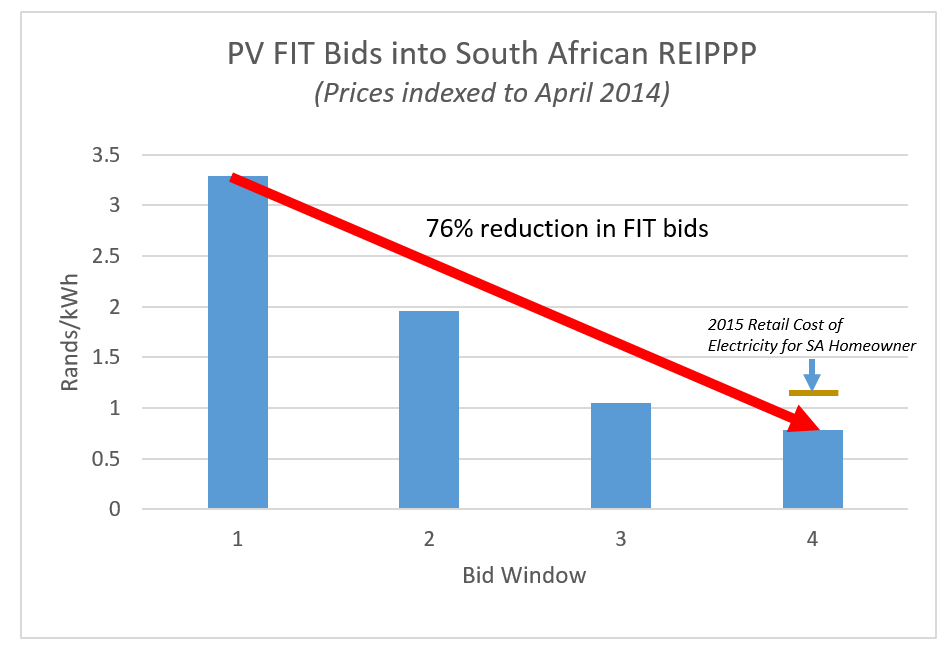
  4. Renewable energy is expensive. The cheap price of retail electricity in Botswana further complicates matters because REIPPs may initially require higher feed-in tariffs than the present retail rate of 88.28 thebe/kWh to run a profitable renewable-energy enterprise. Again, lessons can be drawn from the South African REIPPP. At the start of this program, bid prices in the auction were high, but then, over the succeeding annual bid windows, prices fell as investors gained confidence and experience in the South African renewable energy market. When the program started in 2011, the average bid for renewable energy was R 3.29/kWh (US$ 0.198/kW @ R16.61/$). This has decreased every year and fell to R 0.79/kWh ($ 0.047/kW) in the most recent bid window – a remarkable 76% reduction over four years. This is below the R 1.14/kWh that the average homeowner (using <600 kWh/month) is paying the national electricity supplier, Eskom (see the figure below). The program is a fine example of the results that a well-crafted, consistent, and predictable program can deliver. If large-scale renewable energy/solar is introduced to Botswana, it is very likely that the average tariff required by the developers for the first projects will be higher than the retail price for electricity. In a way, this will become a subsidy for renewable power and is similar to the subsidies presently supporting coal-fired electricity generation in Botswana. Yet, drawing from the South African experience, there is the possibility that, over time, as more projects become implemented, the bid prices for renewable tariffs will decrease, although because Botswana does not have the same degree of needed capacity, such decreases will most likely be smaller.                                                                                
                                                                                                                             Source: SA DOE
  5. Solar energy is highly variable: it only produces electricity during the day and what Botswana needs is more consistent base-load production of electricity. I cannot argue with the point that Botswana needs a larger amount of reliable base-load electricity generation, especially considering that the writing of this post was interrupted several times by the lack of electricity due to load shedding. However, even though solar energy is variable, the production of electricity from PV systems will lessen the amount of coal that needs to be burned during the day time. Reduced coal burning has a positive impact on the planet and environment, it extends the lifetime of the coal resources, and it provides some diversification for electricity generation, which, in turn, reduces the vulnerability of energy supply.                                                                                                                                                                                                                          
  6. There is a lack of knowledge about solar systems and lack of trained personnel in Botswana. I have found this to be only partly true. There are a limited number of Botswana-based solar firms and trained personnel at the moment, but this is due to the limited amount of business available in the country. I have met several competent and well-trained engineers and technicians in the PV field in Botswana and I am confident the knowledge and expertise base will grow as the business grows – as it has in all other countries where solar energy has been promoted.                                   
  7. Concern about the impact of grid-connected PV systems on the main electrical grid. The connection of multiple small generators onto an electrical grid does add complexity to its operation, but the experience of other countries can easily and quickly be drawn upon. Major utilities in Europe, Asia, and the US now accommodate large-scale and highly variable renewable energy production from thousands of individual systems that each feed small amounts of electricity into their electrical grid, as well as from grid-scale PV operations. This is a technical problem that has been solved and Botswana can draw from a well-established knowledge base.                       
  8. Renewable electricity from PV is highly subsidized in developed countries. This is a valid point. We are seeing residential and grid-scale solar installations rolling out across parts of the US and Europe, but this is not because solar irradiation levels are high in these regions. In fact, they are often far lower than Botswana. For example, in my home state of Massachusetts, where there is a major growth in the solar industry, the average solar insolation value  is 3.9 peak sun hours compared with 5.6 in Botswana. Similarly, in Germany, solar irradiation levels are a lot lower: 2.52 in Hamburg and 2.98 in Munich. The reason for the solar bonanza in those countries is that there are tax credits for installation, high FIT levels, and/or generous renewable energy credits to be earned. For example, in Germany FITs in 2015 were € 0.1288/kWh (US$ 0.14/kWh). (This is down from 2004 when they were as high as € 0.54/kWh (US$ 0.67/kWh).) In Massachusetts, excess electricity generated by homeowners can be sold back to the grid for $ 0.1837/kWh through net metering and also earn the homeowner ~$ 0.30/kWh in renewable energy credits.                              
  9. At this time, there are better alternatives for Botswana than renewable energy. Botswana is a developing country and, as such, there are perhaps better alternatives to installation of expensive, long-payback renewable-energy projects. A reading of the most recent annual report for Botswana’s electrical utility, BPC, indicates that their focus is on base-load energy supply, transmission grid reliability, service delivery, financial turnaround, and rural electrification. Renewable energy is not even addressed. Moreover, discussions that I have had with various BPC personnel also suggest a very different viewpoint: when they view the P100 million Phakalane solar PV project, they see a good and interesting project producing enough electricity for 200 to 300 homes, or enough for one village; however, they then emphasize the fact that this same sum of money could be used to bring the grid to approximately 30 villages and impact a lot more people. Ultimately, this is a very important choice to make in a country with limited resources: impacting the lives of many in the short term by extending the grid and burning more coal or that of a few for the long term by installing solar. This is a complex matter, but it is very relevant to the situation in developing countries across the world. It is easy for those of us in the developed world to promote renewable energy, but we have the resources, incomes, the developed economies, and the completely electrified countries to make these choices. Sometimes what works in a developed country is a poor fit for a developing country.

It has taken me some time in Botswana to understand the complexities involved in the consideration and installation of solar projects. Sunshine is a magnificent energy resource for the country and it is clear that small off-grid systems with battery storage in remote areas and a long way from the grid are great alternatives to diesel generators. However, when it comes to large-scale grid-connected systems, the situation is a lot more complicated than I first appreciated and requires a nuanced understanding of the factors at play in the country. One has to balance the short-term needs of development and electrification against the long-term benefits of renewable energy production. One has to understand that renewable energy is not free energy – even though prices are falling: the initial costs are still high and the reason we are seeing large-scale solar PV roll outs in other countries is because energy costs are high and renewable energy is heavily subsidized. Furthermore, one has to deal with the variability of a solar resource and balance that against the need for reliable base-load generation, even though that is achieved by burning coal.

Overall, as these matters often are, it is a complex situation involving a great number of tradeoffs, but this is not to say that solar and renewable energy do not require regulatory and financial support. They do – and there are clearly actions that can be taken to promote solar, such as implementing FIT regulations, establishing subsidies, and training workers skilled in the solar energy business.

It has taken time to come to grips with the complexities of renewable energy in this part of the world. My understanding has evolved and my opinions regarding solar in Botswana are now a lot more educated. Clearly, there is still much to learn and I would be interested to hear your thoughts about this issue. Feel free to drop a comment in the box below or, if you prefer, drop me a note at my email address.

In the meantime, remember to turn off the lights when you leave the room.

Tsamayang Sentle**
Mike Mooiman
mooimanm@franklinpierce.edu


(*Greetings in Setswana)

(**Go well or Goodbye in Setswana)


Wednesday, January 27, 2016

Solar Power in Botswana – Photovoltaics – The Technology

Dumelang*. My last few posts have discussed the potential for harnessing energy from the sun in Botswana. Various ways of doing this include:
  • Concentrating solar power, where the energy of sunlight is focused by mirrors onto a focal point. The focused sunlight heats a fluid that is used to generate steam, which then turns a turbine to generate electricity.
  • Photovoltaic generation of electricity through the use of solar panels.
  • Solar thermal, which uses the heat of the sun to warm up water so that it can be used for showers and other hot water applications like washing.

In this post, I take a look at photovoltaic (PV) technology in general; the next blog will focus specifically on its application in Botswana. PVs generate electricity directly from sunlight using semiconductor technology, which is built into the PV panels. The ever-increasing scope of PV applications ranges from small devices that generate tiny amounts of electricity used to power calculators (outputs in the milliwatt (mW) range), to one- or two-panel systems generating 100 to 300 watts (W) to charge cell phones and provide light, to 2 to 50 kilowatt (kW) systems that power homes and businesses, all the way to grid-scale solar farms with outputs as high as 550 megawatts (MW). Today, we see PV applications all over the place; below are photographs of some solar installations I have observed in Botswana.


We will return to specific solar installations in Botswana later, but first let’s turn our attention to  looking at photovoltaic technology and the main components of a solar PV system.

PV panels produce electricity by the use of semiconductor technology. Most PVs are based on silicon semiconductors, but there are some newer panels that use non-silicon semiconductors. Silicon-based solar panels use bilayer materials of n- and p-type semiconductors. The n-type contains a small amounts of phosphorus in the silicon matrix which creates extra electrons in this layer and the p-type contains a small amount of boron which creates electron shortages or holes. At the junction of these two layers, the electron imbalance creates an electric field that can be used to control the flow of electrons. When panels are exposed to light, the photons in sunlight knock electrons from their positions in the silicon lattice and allows them to flow through an external electric circuit connecting the two types of semiconductor. This generates a small direct current which can then be harnessed. (For a more detailed explanation, here is a great YouTube video worth watching.)

Assembling many of these cells into a solar panel (modern panels typically contain 60 individual cells) allows their flows to be combined and permits larger flows of electricity. The first power solar cell was developed in 1954 and, since then, the key driver in solar cell research has been to improve the efficiency of these devices. Overall, solar panels are still low-efficiency devices with average efficiencies of converting sunlight to electricity of about 15%, although newer panels are now reaching efficiencies of the order of 22%.

The components of a solar system include the following:
  • Solar panels – Most commercially available panels measure ~1.6 m x 1 m and produce 150 to 250 W with a direct current (DC) output that can range from 15 to 60 volts and 3 to 7 amperes. The outputs of the individual panels are combined by wiring them in series or parallel configurations: connecting them in series boosts the output voltage, whereas parallel connections provide a larger current. The combination of these two wiring modes provides a range of voltage and current outputs that can be tailored to meet the requirements for a specific application.
  • Inverter – Most household and business appliances operate on an alternating current (AC) supply, so the direct current (DC) electricity that is generated from the panel must be converted to AC, which can then be feed directly into the grid or used locally. This is done by the inverter. Today, some DC appliances and lighting are available, which can eliminate the need for an inverter.
  • Charge controller – This is an electrical interface between the solar panels and the batteries that is used to ensure that the batteries receive the correct charging voltage and current. The electrical outputs of the panels vary during the day with changes in the sunlight intensity, so these devices prevent the over- and undercharging of the batteries. Charge controllers and inverters are often combined into a single multipurpose electrical component.
  • Batteries – These are usually lead acid batteries specifically designed for deep-discharge applications. They are quite different from car batteries. Car batteries are designed to put out a lot of power for just a short period of time to turn over the car engine when it is first switched on. Deep-discharge batteries are designed for cycling applications where there is moderate power draw over a long period of time, say during the evening, and recharging every day.  The two are not interchangeable. Not all solar systems include batteries, but battery storage systems are becoming an increasingly important. Many people have chosen to just install battery storage systems in their homes without solar panels to have some electricity available for when the electric grid is down during load-shedding periods. In a future blog, I will be taking a much closer look at battery storage systems.

There are two kinds of PV systems:  grid-connected and off-grid systems. In grid-connected systems, the AC output of a solar operation is fed into the electrical grid to supplement the power produced by other power plants. These operations usually do not include any storage so they can only generate and supply power to the grid during daylight hours. The supply from these operations is therefore highly variable: low in the mornings and afternoons, high at midday, and cloud cover significantly reduces their output. The electrical grid needs to be managed to adjust to this variable output. Most systems in Europe and the US are grid-connected and range from large utility-scale systems to smaller home-based units in which electricity produced during the day in excess of that used by the homeowner is fed back into the grid. These systems are often bidirectional: during the day, electricity is supplied to the grid; during the night, when no solar electricity is produced, power is drawn from the main electrical grid.

The other type of solar system is not connected to the main electrical grid. These are known as off-grid systems and are typically found on homes, on farms, in villages, or at tourist lodges in remote areas. These usually incorporate batteries so that any excess energy can be stored for use during evening hours. During the day, the sun generates electricity that is used to power the site, while excess electricity is stored in batteries to provide power for the evenings. Off-grid systems are sometimes combined with other means of electricity generation, such as diesel generators, that can provide backup power during cloudy conditions or when the batteries are depleted. These are referred to as hybrid systems.

Some solar systems combine grid-connected and off-grid systems. These have battery storage, but are also connected to the grid. These operations generate some or all of the electricity needed by the homeowner or business during the day and any excess is stored in the batteries (as opposed to sending it out to the grid); however, the grid connection is there to provide any shortfalls in power production from the solar panels or when the batteries are depleted. These systems offer the best of both worlds – they produce and use renewable energy so their electricity purchases from the grid are reduced, but the electrical grid is there as a standby to cover any shortfalls in energy production.

Although PV technology has been around for a long time and its applications have been expanding, it is only recently that we have seen significant growth: in fact, the roll out of electrical power generation from PV panels during the past decade has been quite phenomenal. The figure below shows the exponential growth. It was forecast that that there would be over 200 gigawatts (GW) of installed solar capacity by 2015—some 1% of the world’s total installed generating capacity—and that this would double by 2019 to 400 GW.

Source: Wikipedia

This growth has been driven by two factors:
  • Prices of solar systems have dropped, caused by improvements in PV technology, improved manufacturing processes, accelerated Chinese production, and, in some cases, the overproduction of solar panels. In 1977, the price of solar modules was $ 77/W; by 2013, the price had dropped 100-fold (!) to $ 0.74/W. This astounding price reduction is charted in the figure below. Today’s solar module pricing is now of the order of $ 0.50/W.
  • The implementation of renewable energy programs in Europe, Asia, and the US that offer large subsidies or feed-in-tariffs (FIT) has made the installation of solar power attractive for homeowners, businesses, and independent power producers (IPP).

 
Source: BNEF


The massive rollout of PV in these regions has made its way down to parts of Africa, notably South Africa. As part of its Renewable Energy Independent Power Producers Programme (REIPPP), South Africa has implemented 1059 MW of grid-scale PV solar projects, with an additional 1255 MW under construction or in development. This does not even include all the small-scale solar projects that businesses, homeowners, and farmers in South Africa have implemented.

Despite the large solar resource available in Botswana, this country has not been part of this rollout. In my next blog, we will look at some of the reasons for this. In the meantime, remember to turn off the lights when you leave the room.

Tsamayang Sentle**
Mike Mooiman
mooimanm@franklinpierce.edu


(*Greetings in Setswana)

(**Go well or Goodbye in Setswana)